Search This Blog

Thursday, May 31, 2012

Summer Camp in Central Minnesota: Without Camp Songs or Campfires.

Hmmm.... Codex, or Scroll?

Next week marks the 2012 iteration of the Minnesota Manuscript Research Laboratory (MMRL), a one-week workshop introducing participants to several aspects of manuscript studies: paleography, codicology, finding manuscripts, describing manuscripts, Western and non-Western manuscripts, and even early printing.  All of the photographs in this blog entry are of materials from the Saint John's collections that will be used during the MMRL.  Lists of all the manuscripts and incunabula at Saint John's are available on our Special Collections Wiki.  The list of instructors is the MMRL Wiki-site, which is still in development.

Latin New Testament, dated late 13th or early 14th century (SJU Ms. 12)

Detail of f. 3r showing a correction where a word has been scraped off and a new one entered.

The workshop is sponsored by the Center for Medieval Studies at the University of Minnesota and by the Hill Museum & Manuscript Library, Saint John's University (Collegeville, MN).  While the overarching goal of the MMRL is to introduce graduate students to the world of manuscript studies for their research projects, the week is also open to those who wish to deepen their understanding of the early technology for the transmission of knowledge, the manuscript. This year we have eight participants and four instructors (plus a guest speaker).

Preparing for this week brought me back to the recent Introduction to Manuscript Studies by Raymond Clemens and Timothy Graham (Cornell UP, 2007).  This wonderful volume provides a very broad and yet detailed account of the terminology, concepts, issues, and methods for manuscript studies.  It provides for manuscripts what Philip Gaskell's New Introduction to Bibliography (Oak Knoll, 1995) does for early printed books.  Both volumes are useful to new scholars and advanced scholars alike.


Folio 3v of SJU Ms. 12.

Corrections using a red line to strike out the text (fourth line from bottom), combined with dots under the text to be omitted. Also, a word to be inserted at the bottom of the column.

For example, Clemens and Graham reminded me of the ongoing process in the Middle Ages to make sure that the text of the manuscript was as accurate as possible. To this end, one finds many examples for manuscript corrections in the Saint John's collection also.  One manuscript, a late 13th or early 14th-century copy of the New Testament in Latin (possibly from Paris?) also uses a vast number of abbreviations.  Since the Latin text is commonly available in printed editions, this manuscript provides a good exercise for practicing the recognition of abbreviations, letterforms, and corrections.


Folio 7v of SJU Ms. 12, with correction in the left margin.

This correction includes a small symbol (%) that matches a symbol in the text to show where the missing text is to be inserted.

Now for a small confession, the samples I have been showing were found not from the manuscript itself, but from our digital photographs of the manuscript.  Codex 12 is tiny, only about 5 inches tall, and the handwriting is extremely tiny.  You can see the entire manuscript here. Working from the digital copy was easier (and less risky) than working with the actual manuscript itself! However, working with the original brings its own rewards.

There are other topics to be discussed during the MMRL, such as interesting marginalia ...

"Marco de Fasana e un bestiale ignorante ..." from SJU Ms. 4 (Latin Grammar in Humanist hand).


Beyond paleography, however, there are codicological questions to be discussed during the MMRL.  One such question concerns the nature of book binding itself.  Often, it is more useful to work with a book that has sustained damage over the years rather than to work with one in pristine condition.  If the backing for the spine has come off, then it is possible to see exactly how the book's binding is constructed.

Elements of the binding (such as the head band, the use of leather thongs to tie the gathering together, etc.) can be easily seen in this binding on an incunable edition of Servius' commentary on Virgil (1471).

Other types of stitching for book bindings might be common elsewhere. This and the picture below show the binding of an Ethiopian manuscript (probably 18th or 19th century, so not "medieval"). 

Note the interweaving cord loops of the Ethiopian binding. This is quite different from European bindings with leather thongs or cords onto which the gatherings sewn.

My part in the MMRL will be largely running books up and down stairs between the classroom and the rare books rooms.  Unfortunately, our only elevator is out of service at the moment, so I really will be "running."  This is also unfortunate, because one of our favorite manuscripts to show is a late-medieval antiphonal which is about 30 inches tall and weighs (I am guessing) close to 50 pounds--not easily carried up the stairs!

I will also give a presentation on early printing, especially from the 15th and early 16th centuries.  Since SJU has over 65 incunabula, limiting my presentation to one hour will be a challenge!  However, the focus of MMRL is not printed books, but manuscripts.  Here are a couple samples from the books I will be presenting:

1485 Missale with extra decoration to imitate manuscript style.  Printed in two colors, with red staves for music, there are no notes printed on the staves.

1493 Missale that does have musical notation printed on the red staves.  It also has hand-written marks over several of the pericopes that indicate that perhaps the text was chanted or sung (more on this in the Special Collections Wiki page on incunabula).

The three Saint John's collections (Saint John's Rare Books, Arca Artium Rare Books, and HMML Rare Books) offer many opportunities to study the development of the book (introduction of title pages, foliation, catchwords, illustrations, etc.) over the course of the latter half of the fifteenth and first half of the sixteenth centuries.

A 1482 glossed edition of Gratian's Decretum.

The end of a 1494 edition of Boccaccio with printer's device and colophon.

Woodcut from the 1494 Boccaccio. The edition features several pages of woodcut diagrams.

Two early examples from the early 16th century are specifically Benedictine--a copy of the Rule of Benedict in Italian (1501) and a copy of the second Dialogue of Gregory (Life of Benedict), the Rule of Benedict, and a short work by Bernard of Clairvaux (1505)--all in Latin.

1501 Italian translation of the Rule of Benedict, published by Lucantonio Giunta.

Saint Benedict, holding a book (a copy of the Rule), next to his two closest followers, St. Placid and St. Maur.

Title page of the 1505 Latin edition containing Gregory the Great's second Dialogue, the Rule of Benedict, and a work by Bernard of Clairvaux.  This is also published by Lucantonio Giunta, whose publisher's device appears on the title page.


The Benedictines have the tradition of welcoming guests with a greeting of "Peace!"  HMML and the Center for Medieval Studies welcome our visitors with

PAX!

We hope to see you soon ...


Thursday, May 17, 2012

A Marriage of Sorts

One of these books is not like the others ...

Every so often, one gets the opportunity to try piecing together a puzzle or two.  This week I would like to talk a little about the marriage (so to speak) of two sets of an 18th-century title, the Neu-vermehrtes historisch- und geographisches allgemeines Lexicon, by Jacob (Johann?) Christian Iselin (1681-1737).

Back in 2009, I received an e-mail from a member of the Douglas County Friends of the Library (in Alexandria, Minnesota).  The "Friends" had received an anonymous gift of a large book in German that was dated 1728.  They wanted to know what the book was and whether it was of value to anyone.  After an exchange of e-mails, digital photos, etc., I was able to determine that it was volume two (covering entries starting with the letters D through I/J) of the four-volume Lexicon by Iselin.  It was second edition and--like hundreds of volumes in our collections--was bound in blind-stamped pigskin. I suggested that the Friends might want to contact the few American libraries that have this title to see if anyone needed this volume to complete a set.


Close, but no match.

In February 2012, the Friends contacted me again.  They had not found a home for their errant volume and were curious as to whether HMML (www.hmml.org) would want to purchase the volume for the rare book collections at Saint John's.  My initial reaction was one of uncertainty--one volume from a multi-volume dictionary or encyclopedia is generally not of great value to scholars.  I suggested that I look further at online antiquarian dealers to determine a general price range for the Iselin.

The different colors of the pigskin indicate a little of the different histories these volumes have lived.

While searching for a possible price, I stumbled upon a copy of Iselin's Lexicon for sale that included only volumes 1, 3 and 4.  These volumes were also bound in blind-stamped pigskin.  The immediate hope (and for all librarians, hope springs eternal) was that this was a complete set and that we could somehow re-unite a family.  The chances were already minimal at best, but it became clear that these were different when I matched up the bibliographic records and found that volume two came from the second edition or Auflage (1728), while the other volumes were from the first edition (1726-1727). 

Clasps and bevelled boards on vol. 2 are different from the bindings on volumes 1, 3 and 4.

The book dealer was Esther Geller, at Elgen Books, located on Long Island, New York.  We corresponded by e-mail and I was able to place an order for the three volumes.  Ms. Geller demonstrated great patience with the bureaucracy at our institution while awaiting payment, but we finally go everything processed and the books came a few days later.  The ownership plates in the three volumes indicated that these were once in the Library of the Protestant Episcopal Divinity School in Philadelphia.

Detailed ornamentation on all of the volumes as was popular for hand-bound books before 1800.

Title page of volume one.

Sometimes the title seems to take as long to read as the book itself.  A partial transcription of the title page gives us:  Neu-vermehrtes historisch- und geographisches allgemeines Lexicon : in welchem das Leben und die Thaten und andere Merckwürdigkeiten deren Patriarchen, Propheten, Apostel, Vätter der ersten Kirchen, Päbsten ... vornehmer Gelehrten und anderer ... berühmter Männern und Künstlern, nebst denen so genannten Ketzern : wie nicht weniger derer Käyser, Königen, Chur- und Fürsten, Grafen, grosser Herren, berühmter Kriegs-Helden und Ministern ... und endlichen die Beschreibung derer Käyserthümern, Königreichen, Fürstenthümern ... dissmahlen von neuem mit Fleiss gantz übersehen ... und um ein grosses vermehret ... von Jacob Christoff Iselin ...


Published in Basel, the editor made sure to include the list of mayors of the city from the late Middle Ages up to the time of the Lexicon.


One of the distinctions between the two sets of the titles was the use of bevelled boards on volume 2 (dated 1728).  The boards on the three volumes from 1726-1727 were not bevelled on the edge.


Title page of volume two, with the note that this is the second edition (Zweyte Auflage) and an ownership stamp from "FH."


Perhaps the best reward of this exercise lay the new relationships that this book transaction started.  Not only was it a pleasure to work with Esther Geller, but the contact person for the Douglas County Friends of the Library came to visit HMML.  She and her colleague were able to see the Saint John's Bible and have a brief tour of the rare book collections at Saint John's, and even to learn a little about HMML's preservation mission.


List of the early kings of France .


So, HMML ended up with a "mixed set" from the first and second editions of Iselin's Lexicon.  While we did not re-unite a family, we did create a new "hybrid" family that can serve future scholars.  The coverage of each volume was the same from one edition to the other, so we have the complete contents.


Monday, April 30, 2012

HMML and Manuscripts at Kalamazoo!

Fragment from a book binding. Ms. Frag. 1, Hill Museum & Manuscript Library.

Every year a huge (but very well-behaved) crowd descends on Kalamazoo, Michigan, to spend four days discussing the history, literature, culture, music, law, life, and much else from the Middle Ages.  The International Congress on Medieval Studies (ICMS) is the largest (and longest-running) such gathering in the world.  The Hill Museum & Manuscript Library (www.hmml.org) has been active at Kalamazoo for decades now.  This year (2012) marks a high point in our participation as HMML will be displaying eight manuscripts from its own collections at the Congress.  HMML has numerous medieval manuscripts including seven books of hours, a gradual, two antiphonals, and several smaller, personal manuscripts. While the fancier Books of Hours are staying at home (in Collegeville), some representational items will travel to Michigan.

SJU Ms. 2, a Graduale from the 14th century.
The cover of the Graduale has been recycled from another manuscript.

The selection for the 2012 ICMS includes a 14th-century Graduale with decorated initials, an early 17th-century Book of Hours (no miniatures or decoration, I'm afraid), a Confessionale copied about 1500, a preacher's manual and a couple monastic miscellanies.  There is even an Ethiopian prayer scroll (not medieval, mind you) that demonstrates the diversity of our collections.

A Book of Hours copied in 1609 for use by a Cistercian nun.

The manuscripts will be on display at the Meader Room in the Special Collections and Rare Book Department, on the third floor of Waldo Library.  The Library is across the street (more or less) from the Bernhard Center.  Many thanks are due to Sue Steuer and the Special Collections for hosting us at ICMS!
Barton Williams Ms. 2, Hill Museum & Manuscript Library.


A good task for a codicologist--Barton Williams Ms. 2 has bosses on the covers and parchment charters recycled into pastedowns. Since these pastedowns are loose, one can see the structure of the book even better.

In addition to the exhibition, the Special Collections and HMML are co-sponsoring three sessions to be held at the Meader Room:
  • Session 97 (Thursday at 1:30): Describing Digital Images of Medieval Manuscripts Using Dublin Core: Projects and Proposals (A Panel Discussion)
  • Session 151 (Thursday at 3:30): Manuscripts (and Surrogates) in North America: Experiencing the Hill Museum & Manuscript Library (A Roundtable)
  • Session 233 (Friday at 10:00): Reuniting Texts: Libraries Dispersed and Books Unbound
In addition to these sessions, HMML is also co-sponsoring a session with the Texas Medieval Association on Mediterranean Identities (Session 462, Saturday at 3:30, in Valley II, Room 204).

A monastic miscellany -- only about half of the original manuscript is still in this volume.


For those interested in the exhibition, it will be open whenever the Special Collections are open during the Conference.  There will also be a chance to view the books at the HMML reception which will be held in the Meader Room on Thursday, at 5:00 pm.

A short (2-minute) video on the Graduale that will be on display.


Ms. Or. E 8, an Ethiopian prayer scroll (late 18th/early 19th century).

I look forward to visiting with you all in the friendly environs of Western Michigan University--only about 10 days away!

Friday, April 20, 2012

Lacking directions but following clues, or, CSI Special Collections

So what does she know about this book that I don't?
From Joseph Neusinger's Papatus nunquam errans in proponendis fidei articulis
(Augustae [Augsburg]: Typis Joannis Michaelis Labhart, 1709).

Cataloging rare books and manuscripts can be a lot of fun--most of the time.  There are occasions when one wants to throw one's hands in the air and cry "alas and alack" (or in this case, perhaps "alas and a lack," but more on this below).


Today I am going back to some of the many "problem" titles that are left from a big cataloging project that our library undertook in the years 2004-2008. The Hill Museum & Manuscript Library is responsible for a collection of about 10,000 rare book titles, spread across three different sub-collections. When we started a Mellon Foundation-funded cataloging project in 2004, about 1100 of these titles had been cataloged. The rest had either 1) never been cataloged (but listed in a short-title catalog), 2) cataloged on paper in Dewey classification; 3) cataloged on paper in Library of Congress classification, or 4) none of the above.

Initial from an uncataloged 1514 Basel edition of the Plenarium, or collection of pericopes in German.
  
After four years, we had added about 8400 or 8500 rare titles to our online catalog.  Since 2008, I have been cataloging little pockets of materials as I have identified them or as I have found spare time (please don't tell my boss about finding spare time ...) to spend researching incomplete items.  It is some of these incomplete volumes (hence the "lack" mentioned above) that I wish to discuss today.

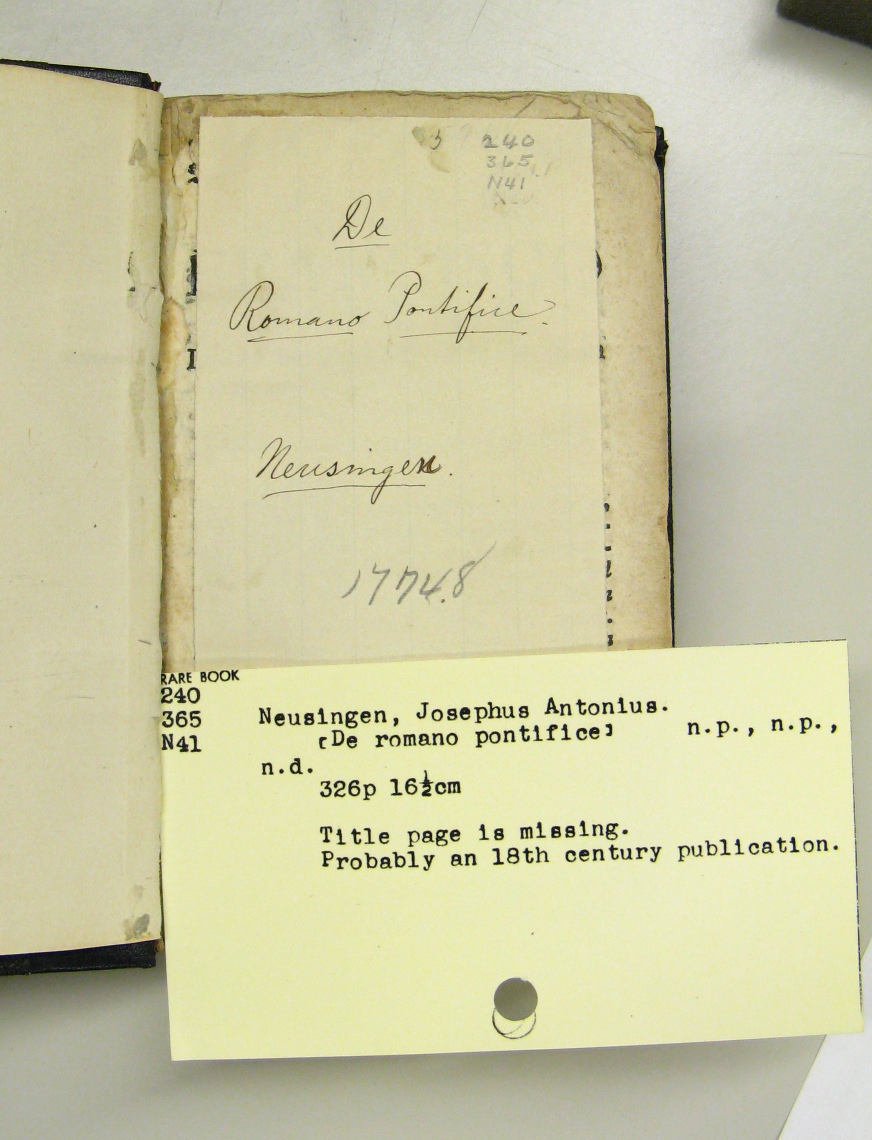
Johann Neusinger. Papatus numquam errans ... (Augsburg, 1709).
Note the confusing title of De Romano Pontifice,
taken from the caption title. The original
cataloger identified the author as Neusingen, not Neusinger.
Many uncataloged items in our arrearages are there because they are incomplete in some way (e.g., perhaps they might be isolated volumes of a large multi-volume set) or because they are combined with other titles in a particularly daunting manner (see my earlier post on "Enough already."  Sometimes, the books merely lack some pages.  Unfortunately, the page that is most often (or most noticeably) wanting is the title page.

Neusinger's title page from the Internet, with earlier cataloging card.
It is amazing how dependent modern readers became upon the title page for information identifying a book.  The earliest printed books did not have title pages--nor colophons, nor pagination, nor lots of other things we take for granted.  For a while in the fifteenth and sixteenth centuries printers and publishers kept much of the most important information about the book in a colophon at the end of the volume.  Here we could find the title of the book, perhaps its author, the publisher's name, the place of publication, the date of publication, and other salient facts that would distinguish one edition of a work from another.

Antonio Pereira de Figueiredo's De non definita in concilio Tridentino (Olisipone, 1766). Note the somewhat unhelpful generic title given by a previous owner ("Dissertatio historico-theologica"), and the partial name of the author.  Fortunately, about 30 pages into the book one can find the actual beginning of the text with a caption title that matches the title page title. No copy of the text was found online, but another institution had already cataloged a copy that appears to match this title (which apparently was only published once).

In the sixteenth century this information moved to the title page for the most part, and now we look there first for a book's identification, and then to the colophon, if there even is one.  But what if the title page is no longer in the book?  There are many reasons a book may lack a title page, which I won't expand upon here, except to say that many of HMML's books are likely remnants of European monastic collections which were "secularized" at some point in the eighteenth or nineteenth century (we know this is true of about 1100 books that came from two Bavarian monasteries). Since title pages often have ownership notes or stamps on them, it is possible that many were removed to obscure the origin of the volumes a long time ago.

Plenarium, dated 1514 (Basel) according to a handwritten note on the book. The volume is lacking its title page and colophon.

One of the wonderful woodcuts in the Plenarium, a collection of Gospel and Epistle readings arranged for the liturgical year.

So close, but no ...  The Bavarian State Library reports two editions of this work published in 1514 in Basel.  They even had pictures of one of these editions available through VD16.  Unfortunately, as we can see, the two pages are dissimilar enough to indicate that this is NOT the item they have photographed. I am still waiting for pictures of the second edition to be put onto the Internet.
HMML has several such works lacking title pages and/or colophons.  Among these are a printed book of hours, a Plenarium (or collection of Gospel and Epistle readings in the vernacular), partial works by Virgil and Pliny the Elder, a commentary on the Song of Songs by Jaime Perez, a collection of inscriptions from the earlier basilica of St. Paul's Outside the Walls in Rome, and several others.

As a cataloger, these books pose special problems, however.  One needs to identify the author and title, and--especially in the case of popular works--the printer, date and place of publication.  Without these, it becomes nearly impossible to identify the work in one's hand.  One movement toward such identification came in the massive 800-volume National Union Catalog of title before 1956.  Today, catalogers and others turn first to WorldCat (OCLC), where nearly all known printed editions are represented.  However, to search a database like WorldCat, one needs certain details--author, title, publication data, etc.

The second volume of Pliny the Elder's Natural History in a 1608 edition from Frankfurt. By searching clues like the commentary by Paolo Cigalino and the printer's device (which also appears at the back of the book as a colophon), I was able to narrow the probably candidates as a matching edition.
I have worked through various sources to identify several of our books in recent months.  With the unprecedented access to catalogs from other countries, I have identified books and editions with the help of WorldCat, VD16 (16th-century books printed in Germany), VD17 (17th-century books printed in Germany), the ESTC (English Short Title Catalogue, the ISTC (Incunabula Short Title Catalogue), as well as services like the Bibliotheque Nationale's Gallica, union catalogs in Italy (SBN), other national library catalogs and union catalog interfaces from across Europe.  And of course, there's always Google, Google-Books, and numerous digitization projects across Europe and North America.

Finally, one example of a search:  HMML has a volume whose handwritten title page identified it only as Canones et decreta omnium Conciliorum usque ad Tridentinum, compiled by Barth. Carranza.  No dates were given, no publisher, etc.  One important clue was the colophon that indicated that the book had been printed at the shop of "Ioan. VVithagij." in Antwerp, Belgium. On the following page was a publisher's device, which I was eventually able to trace to the family of Ioan. Steelsij.  The most commonly reported editions in WorldCat did not match in the number of pages, an important attribute for preliminary comparisons.


Eventually, I was able to establish that most editions I had found were published by the widow of Joannes Steels (as the Library of Congress identifies him in the LCNAF).  This narrowed my focus to 16th-century editions of Carranza's compilation. Since later editions included later Councils, it seemed likely that this edition must have appeared within a couple decades after the end of the Council of Trent, as suggested by the handwritten title. In final desperation, I searched for the name "Carranza" in Google Books, limiting the dates to 1550 to 1560.


Sure enough, Google has a digitized version of the entire book in a copy from the Bavarian State Library. I was able to compare numerous pages and verify that this was the same edition that HMML has.  With that, I was able to print out a surrogate title page to identify our copy (to keep with the book) and to identify a record in WorldCat that matched our copy.

Today, Carranza is on the shelf in the appropriate place!  Now to find some more missing title pages (if I can find any spare time ...).


Sunday, March 18, 2012

Benedictines and Books, part 3

An angel points the way for St. Etheldreda or Audrey (ca. 636-679), queen and virgin.


"Benedictine READ Posters"

As my title indicates, I have already written a couple times on the importance of the relationship between the Benedictines and the history of the book. It is a story that could take many years to describe--more years than I have to be a blog writer. These posters are small, so that they can be easily viewed on a computer. Most of the original pictures in this posting have been adapted from a book in Vivarium, the online image database of the Hill Museum & Manuscript Library: Imagines Sanctorum Ord. S. Benedicti by Karl Stengel (Augsburg, 1625); see: http://cdm.csbsju.edu/u?/SJRareBooks,15000. Only the picture of Saint Benedict (below) comes from a different source.

As always, you can click on any picture to see it enlarged and to see a gallery of images in this blog post.

So, today I would like to offer a little something (something rather "corny" as they say) for the enjoyment of others:  Following the example of celebrities with books instructing us to read, I thought I might offer up a few Benedictine celebrities with their books.  Since I was not authorized to do this on work time, I created these "posters" at home, using pictures from books in the Saint John's Rare Collections. I hope others will enjoy these. Should anyone find fault with my Latin, please direct comments to me, not the public at large!

Blessed Abbot Alcuin of York (ca. 735-804) teaching his community.
Alcuin was a famous educator and author who also helped Emperor Charlemagne establish an important collection of classical literature in his capital in the late 8th century. As the biographer Einhard tells us:

"Another deacon, Albin of Britain, surnamed Alcuin," a man of Saxon extraction, who was the greatest scholar of the day, was his teacher in other branches of learning. The King spent much time and labour with him studying rhetoric, dialectics, and especially astronomy; ..." (Life of Charlemagne, by Eginhard (i.e., Einhard). New York: American Book Co., 1880. Available in Google Books.)


Benedict of Nursia (ca. 480-ca. 547) with his favorite reading, the Bible,
in the Sacro Speco (Holy Cave) at Subiaco, Italy.

In most pictures of Saint Benedict, the founder of Benedictine monasticism, he is depicted holding a book--often a Bible or a copy of his rule for monks. In the poster of Benedict at Subiaco, it is clear that the book is a Bible, since the Rule had not yet been written. The original picture comes from a book on the Sacro Speco in the Saint John's Rare Books Collection. While the Rule of Benedict says relatively little about books per se, it does call upon his followers to read as a regular part of their life as individuals and as community.

Even the Virgin Mary encourages us to read. Rupert von Deutz
receives a book from the Virgin and Christ Child.


Rupert von Deutz (1075-1129) was a famous preacher and theologian in the high Middle Ages. Even though his work was later questioned by Church authorities, he is still studied today.

Saint Walburga with her special "oil" and her book in one hand
and an abbess' staff in the other.


Saint Walburga (ca. 710-777 or 779) also promotes reading in her portrait. Born in England, her remains rest today in Eichstätt, Germany, which is also home to a woman's monastery named in her honor.  The Hill Museum & Manuscript Library has digitally photographed a German-language biography of Walburga which has been added to its image database, Vivarium (http://cdm.csbsju.edu/u?/SJRareBooks,20805).

Finally, to demonstrate the tenacity of the Benedictine readers, I offer this image of Saint Eulogius of Cordoba (martyred in 859):

Saint Eulogius of Cordoba (died 859) who gathered works by Augustine
and ancient Latin authors and brought them to his home in Cordoba.

Happy reading!