Search This Blog

Sunday, March 18, 2012

Benedictines and Books, part 3

An angel points the way for St. Etheldreda or Audrey (ca. 636-679), queen and virgin.


"Benedictine READ Posters"

As my title indicates, I have already written a couple times on the importance of the relationship between the Benedictines and the history of the book. It is a story that could take many years to describe--more years than I have to be a blog writer. These posters are small, so that they can be easily viewed on a computer. Most of the original pictures in this posting have been adapted from a book in Vivarium, the online image database of the Hill Museum & Manuscript Library: Imagines Sanctorum Ord. S. Benedicti by Karl Stengel (Augsburg, 1625); see: http://cdm.csbsju.edu/u?/SJRareBooks,15000. Only the picture of Saint Benedict (below) comes from a different source.

As always, you can click on any picture to see it enlarged and to see a gallery of images in this blog post.

So, today I would like to offer a little something (something rather "corny" as they say) for the enjoyment of others:  Following the example of celebrities with books instructing us to read, I thought I might offer up a few Benedictine celebrities with their books.  Since I was not authorized to do this on work time, I created these "posters" at home, using pictures from books in the Saint John's Rare Collections. I hope others will enjoy these. Should anyone find fault with my Latin, please direct comments to me, not the public at large!

Blessed Abbot Alcuin of York (ca. 735-804) teaching his community.
Alcuin was a famous educator and author who also helped Emperor Charlemagne establish an important collection of classical literature in his capital in the late 8th century. As the biographer Einhard tells us:

"Another deacon, Albin of Britain, surnamed Alcuin," a man of Saxon extraction, who was the greatest scholar of the day, was his teacher in other branches of learning. The King spent much time and labour with him studying rhetoric, dialectics, and especially astronomy; ..." (Life of Charlemagne, by Eginhard (i.e., Einhard). New York: American Book Co., 1880. Available in Google Books.)


Benedict of Nursia (ca. 480-ca. 547) with his favorite reading, the Bible,
in the Sacro Speco (Holy Cave) at Subiaco, Italy.

In most pictures of Saint Benedict, the founder of Benedictine monasticism, he is depicted holding a book--often a Bible or a copy of his rule for monks. In the poster of Benedict at Subiaco, it is clear that the book is a Bible, since the Rule had not yet been written. The original picture comes from a book on the Sacro Speco in the Saint John's Rare Books Collection. While the Rule of Benedict says relatively little about books per se, it does call upon his followers to read as a regular part of their life as individuals and as community.

Even the Virgin Mary encourages us to read. Rupert von Deutz
receives a book from the Virgin and Christ Child.


Rupert von Deutz (1075-1129) was a famous preacher and theologian in the high Middle Ages. Even though his work was later questioned by Church authorities, he is still studied today.

Saint Walburga with her special "oil" and her book in one hand
and an abbess' staff in the other.


Saint Walburga (ca. 710-777 or 779) also promotes reading in her portrait. Born in England, her remains rest today in Eichstätt, Germany, which is also home to a woman's monastery named in her honor.  The Hill Museum & Manuscript Library has digitally photographed a German-language biography of Walburga which has been added to its image database, Vivarium (http://cdm.csbsju.edu/u?/SJRareBooks,20805).

Finally, to demonstrate the tenacity of the Benedictine readers, I offer this image of Saint Eulogius of Cordoba (martyred in 859):

Saint Eulogius of Cordoba (died 859) who gathered works by Augustine
and ancient Latin authors and brought them to his home in Cordoba.

Happy reading!

Thursday, March 1, 2012

Global Ethiopia and Rare Books


On March 17, 2012, Saint John's University will be the site of the Global Ethiopia Conference, co-sponsored by the Hill Museum & Manuscript Library, the University Library, the English Department and the Center for Global Education.  As part of this one-day conference, HMML will be showing some of the rare books in the Saint John's collections.  Below is a short overview of some of these books. For more on the conference, visit:


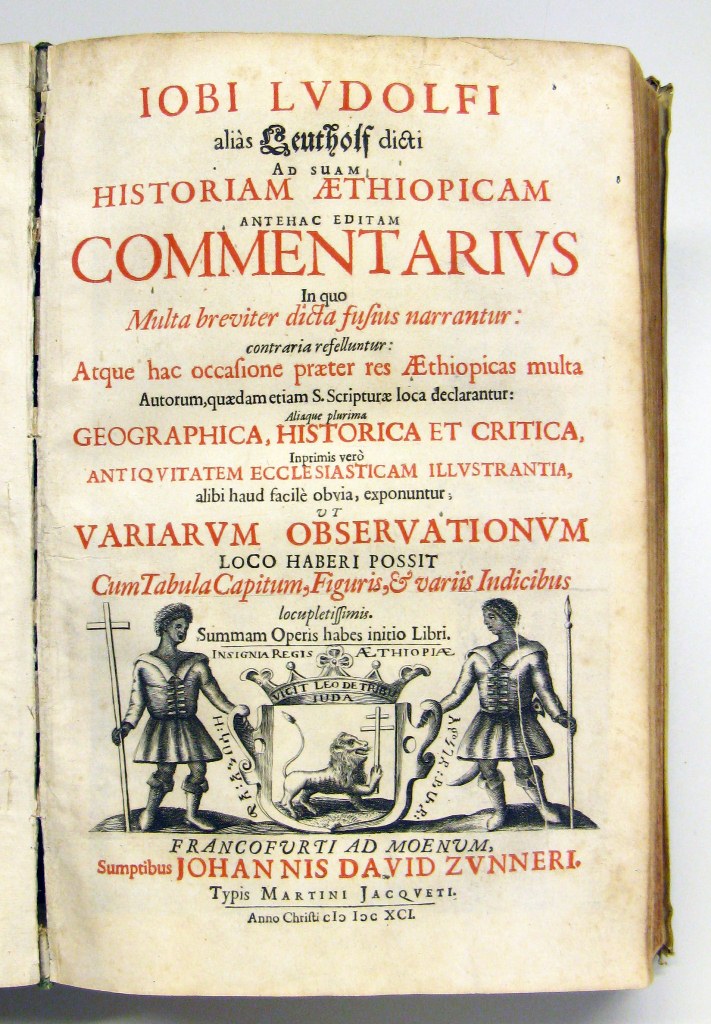
From the Historia Aethiopica by Hiob Ludolf (1681) or its supplement (1691).
Hiob Ludolf (1624-1704) is credited with starting the scholarly research of Ethiopia in Europe.  HMML has his major work, the Historia Aethiopica (Frankfurt, 1681) bound together with its supplement, the Commentarius (Frankfurt, 1691).  His influence can be seen in the rapid dissemination of his works, with English and French editions appearing already in the 1680's.  HMML has a 1684 abridged version in French, as well as a 1701 Psalter in Ethiopic and Latin edited by Ludolf (complete book in Vivarium).

(Click on any image to enlarge it.)


From Ludolf's Commentarius (1691).

Map of Ethiopia from the French abridgement of the Historia Aethiopica (1681).


The rare collections also include French translations of other accounts of Ethiopia, including two from Portuguese and one from English.  There is the Histoire de l'Ethiopie Orientale (or Etiópia oriental), printed in Paris in 1688. This account of life in Eastern Ethiopia includes material on Mozambique, as well) and is based on the Portuguese of the Dominican missionary Joao dos Santos (died in 1622).  Another translation from Portuguese is the Relation historique d'Abissinie  by Jerónimo Lobo (1596?-1678), published in Paris in 1728. This is augmented with numerous essays on Ethiopia by other scholars, including Ludolf.

Another European to wander into Ethiopia was the Scottish explorer James Bruce (1730-1794), who searched for the source of the Nile River.  His account was published in 14 volumes in French as the Voyage aux sources du Nil, en Nubie et en Abyssynie (London, 1790-1792).  The final volume is an atlas of plates, mostly filled with flora and fauna, but also some other scenes from daily life in the Nile River valley.


Joao dos Santos, Histoire de l'Ethiopie Orientale (Paris, 1688).
Jeronimo Lobo, Relation ... (Paris, 1728).
Map from Jeronimy Lobo, Relation ... (Paris, 1728).

From the atlas to James Bruce, Voyage ... (London, 1790ff.)
Finally, we have the renewed interest in Ethiopia among the various works on Africa by British explorers in the 19th century. Richard Burton's First footsteps in East Africa, or, An explanation of Harar (London, 1856) provides a few color plates from that region, while Henry M. Hozier's The British Expedition to Abyssinia (1869) recounts a military invasion by the British to free hostages held by Emperor Tewodros II of Ethiopia.


Richard Burton, First Footsteps in East Africa (1856), title page.


The HMML collections offer other materials on life in Ethiopia, especially religious life and manuscripts (see the earlier post on Ethiopian manuscripts in this blog).  The Global Ethiopia Conference will provide us an opportunity to share these books, manuscripts, and art with a broader audience!

We hope to see you there!

Thursday, February 23, 2012

Enough already!

De sanctissimo divinae trinitatis mysterio, earlier in the library at the Monastery of Ottobeuren,
now in the rare book collection at Saint John's University (Collegeville, MN). More on this title below.


Every cataloger dreads them--multiple titles bound into one item.  And yet, with books (and especially smaller ones) this was a common practice up to the early 19th century, when publishers started issuing books already bound.  Many times these bound-together titles can provide unexpected insights into an earlier time. 

An example of this is a book bound in 1550, according to the date on the binding, but which later came into the monastic library at Ottobeuren (handwritten date of 1598). The first title in the book is a Catholic work called the Loci communes rerum theologicarum by Johann Hoffmeister (Ingolstadt, 1549), and the final title is Encomium aquilae (Tubingae, 1532) written by a Premonstratensian canon who was forced to flee the newly Protestant city of Tuebingen about 1532. 

In between these two "Catholic" works is a title page on which the author's name has been inked out.  Later, someone added the name "Philipp Melanchthon" in ink (his Doctrinae physicae elementa, 1550).  Only then does it become apparent that the outer texts may have been a cover for an author whose close relationship to Martin Luther would not be accepted in a Catholic context.  Now the remaining question concerns the first owner of the book, but unfortunately that information is covered by a later ownership label, which I hope some day to be able to have removed.

And then there are the gatherings of dissertations.  Saint John's has a number of such collections, bound together in one piece, some of them quite early.  One volume bound in pigskin contained 20 different titles, most of which are not widely held in North America.  The ownership note on the first title page indicates that the collection was probably bound in the late 16th century.  The litany of titles required a lengthy note in the catalog record. Here are the contents:

First title: De Sanctissimo Divinae Trinitatis mysterio : disputatio theologica, in celebri et catholica Academia Dilingana, die Ianuarii [sic] publice proposita praeside Georgio Eberhardo ... ; respondente ... Georgio Wölflin (Dillingen, 1588).
This is bound with (see photo gallery below):

-- Mariae Virginis Deique genitricis vita / Joannes Pelecyus. Dilingae : I. Mayer, [1589]
-- De fide virtute theologica disputatio / Joannes Pelecyus. Dilingae : I. Mayer, 1589
-- De spe virtute theologica disputatio / Joannes Pelecyus. Dilingae : I. Mayer, [1590]
-- De charitate virtute theologica disputatio / Joannes Pelecyus. Dilingae : I. Mayer, [1590]
-- De fide, virtute theologica disputatio tripartita / Jakob Mayer. Dilingae : I. Mayer, 1576
-- De ecclesia Christi militante in terris / Joannes Pelecyus. Dilingae : I. Mayer, 1590
-- De originali hominis iustitia et iniustitia / Joannes Pelecyus. Dilingae : I. Mayer, 1586
-- De iustificatione hominis iniusti coram Deo / Joannes Pelecyus. Dilingae : I. Mayer, [1591]
-- De legitimo usu eucharistiae in altera tantum specie / Gregorio de Valencia. Ingolstadii : D. Sartorius, 1587
-- Theologica disputatio, De veritate transsubstantiationis In Sanctissimo Sacramento Eucharistiae / Albert Hunger. Ingolstadii : Weissenhorn, 1577
 -- De augustissimo Eucharistiae sacramento et sacrificio / Joannes Pelecyus. Dilingae : I. Mayer, 1588
-- Disputatio theologica de speciebus Eucharisticis / Jakob Gretser. Ingolstadii : W. Eder, [1594]
-- Disputatio theologica De effectis divinae gratiae / Michael Eiselin. Ingolstadii : D. Sartorius, [1591]
-- De merito proprio hominis apud Deum / Joannes Pelecyus. Dilingae : I. Mayer, [1591]
-- De infidelitate et tribus eius speciebus, ethnicismo, iudaismo et haeresi / Joannes Pelecyus. Dilingae : I. Mayer, [1591]
-- Disputatio theologica de voto et iuramento / Matthias Mayrhofer. Ingolstadii : D. Sartorius, [1589]
-- Theses de descensu Christi ad inferos, et eiusdem ad coelos ascensu / Albert Hunger. Ingolstadii : D. Sartorius, 1587
-- De statu religiosorum / Georg Eberhard. Dilingae : I. Mayer, 1587
-- De tribus peccatorum generibus, mortali, veniali, et originis / Matthias Mayrhofer. Ingolstadii : D. Sartorius, [1587].

Here is a photographic overview of the titles bound into this one volume:

Click on any image to see it enlarged.


And last, and perhaps not least?


Sometimes, the way titles are bound together can give us deeper insight into a time and place distant from our own.  In this case, perhaps, the primary determinant for binding all these titles into one volume was the need to save on binding work in a large library. Either way, these collections pose challenges to the cataloger and his/her stamina!

Now, back to the stacks -- more collections of bound-together titles are waiting!


Wednesday, February 15, 2012

Fine Press Books from the Saint John's Collections


The Hill Museum & Manuscript Library is fortunate to have a very strong collection of rare books and manuscripts that can be used to promote discussion and learning for classes of many ages.  In the Since the end of January, the Library has welcomed many groups to its premises, and staff has also visited groups elsewhere.  Many groups come specifically to hear about the Saint John's Bible.  As I do not work with the Saint John's Bible personally, I devote my presentations to a broad range of subjects supported by HMML's collections.  Here is a list of recent presentations using books and manuscripts from the Library:

Recent Classes Visiting HMML

January 31 - First Year Symposium: discussion on "what is reading" and different kinds of reading
February 2 - Presentation in Minneapolis: Benedictines and books; manuscript culture; preservation
February 9 - Art of the Printed Book
February 10 - Art 101
February 13 - Hagiography
February 16 - Class from Albany High School


Below I will offer a small gallery of photos from the fine press collection at Saint John's.  These books (and several others) were used for the presentation on the Art of the Printed Book, a studio class taught by Rachel Melis at the Book Arts Studio on the campus of our sister institution, the College of Saint Benedict.  Many examples of books and printers/publishers from the years 1890-1940 are also listed on the  Library's Wiki site:

http://hmmlrarebooks.pbworks.com/w/page/49271410/Fine%20Press%20Books

The earliest example of fine press that we discussed was the Kelmscott Press, established and run by William Morris (1834-1896).  The Library has a number of examples from the Kelmscott Press, included one volume published in 1522 with an ownership label indicating that it once was in the Kelmscott library.


Of course, it is difficult to discuss the fine press movement without referring back to earlier influences on their work. So, I also pulled out a title published by Nicolas Jenson in 1475 so that the students could see the work of a fifteenth-century printer who influenced Morris greatly, especially in his type design.


Along with the Kelmscott Press, the students saw examples of work from three presses that followed closely in Morris' footsteps:  the Doves Press, Vale Press, and the Eragny Press.

Volume 1 of the Doves Press Bible.

Doves Press with their typical vellum bindings.

The Doves Press operated for several years under the direction of Emery Walker and T.J. Cobden-Sanderson. Their five-volume edition of the Bible is generally considered their masterpiece and the dramatic initial "I" belies a printing style that is far more sparing in decoration that Morris' own.

Vale Press edition of Shakespear's Macbeth.

Various bindings on books from the Vale Press.

Another example from the Vale Press:  Parables from the New Testament.

The Vale Press was operated by another associate of Morris, Charles Ricketts, who also supported the work of other fine presses.


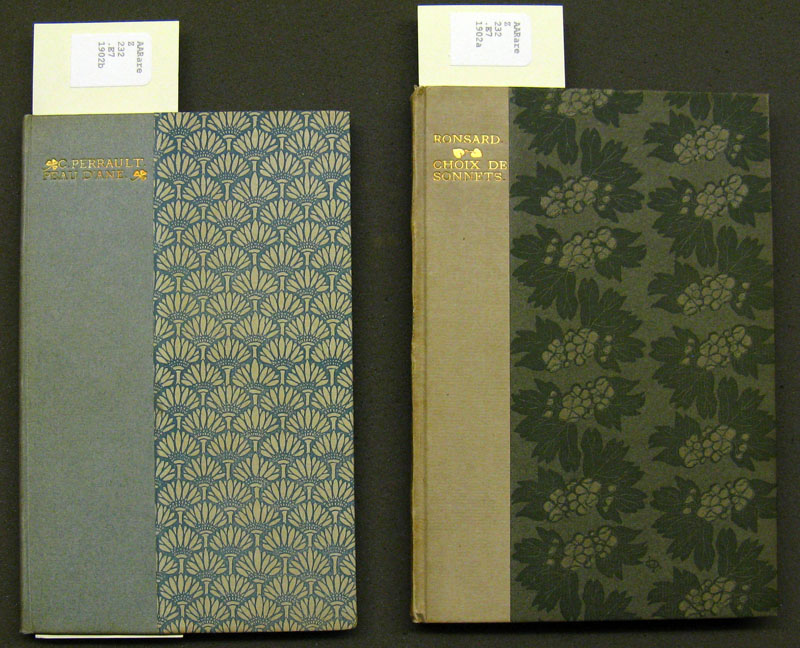
Two books from the Eragny Press, with their distinctive book covers.


The Eragny Press was run by Lucien Pissarro, son of the famous artist Camille Pissarro.  These books display a softer side to the fine-press works, especially in the use of illustration and the now-transformed border decorations from Morris' own style.

Although I use the class to emphasize the international growth of the fine press movement in the 1890's and beyond, I will close here with one more set of examples from England--Saint Dominic's Press.  This press was set up about 1920 (thus about a generation after Morris) as an offshoot of the Guild of Saint Joseph and Saint Dominic, a group of Catholic artisans and artists who broadened the audience for fine press books.  Among the more famous members of this group were Eric Gill (who later worked closely with the Golden Cockerel Press) and Hilary Pepler, who ran the St. Dominic's Press.

Pamphlets and a calendar printed by St. Dominic's Press.

A very large choir book (in Latin) of Christmas hymns, printed by the St. Dominic's Press.
A study in contrasts:  two examples of works from St. Dominic's Press.

Pepler and his colleagues often treated social issues along with religious topics in their publications.  Since many of their works were small, pamphlet-like articles, their works were available to a broader audience.  Gill eventually had a falling-out with Pepler and left, and later Pepler himself was asked to leave. But the guild continued for many years after their departures.

Many of the artists who started during the height of the fine-press movement--Bruce Rogers, W.A. Dwiggins, Frederic Goudy--later became major figures in the design of type, typography and book design in the first half of the twentieth century.  Perhaps we'll hear about them another time ...