Search This Blog

Thursday, February 23, 2012

Enough already!

De sanctissimo divinae trinitatis mysterio, earlier in the library at the Monastery of Ottobeuren,
now in the rare book collection at Saint John's University (Collegeville, MN). More on this title below.


Every cataloger dreads them--multiple titles bound into one item.  And yet, with books (and especially smaller ones) this was a common practice up to the early 19th century, when publishers started issuing books already bound.  Many times these bound-together titles can provide unexpected insights into an earlier time. 

An example of this is a book bound in 1550, according to the date on the binding, but which later came into the monastic library at Ottobeuren (handwritten date of 1598). The first title in the book is a Catholic work called the Loci communes rerum theologicarum by Johann Hoffmeister (Ingolstadt, 1549), and the final title is Encomium aquilae (Tubingae, 1532) written by a Premonstratensian canon who was forced to flee the newly Protestant city of Tuebingen about 1532. 

In between these two "Catholic" works is a title page on which the author's name has been inked out.  Later, someone added the name "Philipp Melanchthon" in ink (his Doctrinae physicae elementa, 1550).  Only then does it become apparent that the outer texts may have been a cover for an author whose close relationship to Martin Luther would not be accepted in a Catholic context.  Now the remaining question concerns the first owner of the book, but unfortunately that information is covered by a later ownership label, which I hope some day to be able to have removed.

And then there are the gatherings of dissertations.  Saint John's has a number of such collections, bound together in one piece, some of them quite early.  One volume bound in pigskin contained 20 different titles, most of which are not widely held in North America.  The ownership note on the first title page indicates that the collection was probably bound in the late 16th century.  The litany of titles required a lengthy note in the catalog record. Here are the contents:

First title: De Sanctissimo Divinae Trinitatis mysterio : disputatio theologica, in celebri et catholica Academia Dilingana, die Ianuarii [sic] publice proposita praeside Georgio Eberhardo ... ; respondente ... Georgio Wölflin (Dillingen, 1588).
This is bound with (see photo gallery below):

-- Mariae Virginis Deique genitricis vita / Joannes Pelecyus. Dilingae : I. Mayer, [1589]
-- De fide virtute theologica disputatio / Joannes Pelecyus. Dilingae : I. Mayer, 1589
-- De spe virtute theologica disputatio / Joannes Pelecyus. Dilingae : I. Mayer, [1590]
-- De charitate virtute theologica disputatio / Joannes Pelecyus. Dilingae : I. Mayer, [1590]
-- De fide, virtute theologica disputatio tripartita / Jakob Mayer. Dilingae : I. Mayer, 1576
-- De ecclesia Christi militante in terris / Joannes Pelecyus. Dilingae : I. Mayer, 1590
-- De originali hominis iustitia et iniustitia / Joannes Pelecyus. Dilingae : I. Mayer, 1586
-- De iustificatione hominis iniusti coram Deo / Joannes Pelecyus. Dilingae : I. Mayer, [1591]
-- De legitimo usu eucharistiae in altera tantum specie / Gregorio de Valencia. Ingolstadii : D. Sartorius, 1587
-- Theologica disputatio, De veritate transsubstantiationis In Sanctissimo Sacramento Eucharistiae / Albert Hunger. Ingolstadii : Weissenhorn, 1577
 -- De augustissimo Eucharistiae sacramento et sacrificio / Joannes Pelecyus. Dilingae : I. Mayer, 1588
-- Disputatio theologica de speciebus Eucharisticis / Jakob Gretser. Ingolstadii : W. Eder, [1594]
-- Disputatio theologica De effectis divinae gratiae / Michael Eiselin. Ingolstadii : D. Sartorius, [1591]
-- De merito proprio hominis apud Deum / Joannes Pelecyus. Dilingae : I. Mayer, [1591]
-- De infidelitate et tribus eius speciebus, ethnicismo, iudaismo et haeresi / Joannes Pelecyus. Dilingae : I. Mayer, [1591]
-- Disputatio theologica de voto et iuramento / Matthias Mayrhofer. Ingolstadii : D. Sartorius, [1589]
-- Theses de descensu Christi ad inferos, et eiusdem ad coelos ascensu / Albert Hunger. Ingolstadii : D. Sartorius, 1587
-- De statu religiosorum / Georg Eberhard. Dilingae : I. Mayer, 1587
-- De tribus peccatorum generibus, mortali, veniali, et originis / Matthias Mayrhofer. Ingolstadii : D. Sartorius, [1587].

Here is a photographic overview of the titles bound into this one volume:

Click on any image to see it enlarged.


And last, and perhaps not least?


Sometimes, the way titles are bound together can give us deeper insight into a time and place distant from our own.  In this case, perhaps, the primary determinant for binding all these titles into one volume was the need to save on binding work in a large library. Either way, these collections pose challenges to the cataloger and his/her stamina!

Now, back to the stacks -- more collections of bound-together titles are waiting!


Wednesday, February 15, 2012

Fine Press Books from the Saint John's Collections


The Hill Museum & Manuscript Library is fortunate to have a very strong collection of rare books and manuscripts that can be used to promote discussion and learning for classes of many ages.  In the Since the end of January, the Library has welcomed many groups to its premises, and staff has also visited groups elsewhere.  Many groups come specifically to hear about the Saint John's Bible.  As I do not work with the Saint John's Bible personally, I devote my presentations to a broad range of subjects supported by HMML's collections.  Here is a list of recent presentations using books and manuscripts from the Library:

Recent Classes Visiting HMML

January 31 - First Year Symposium: discussion on "what is reading" and different kinds of reading
February 2 - Presentation in Minneapolis: Benedictines and books; manuscript culture; preservation
February 9 - Art of the Printed Book
February 10 - Art 101
February 13 - Hagiography
February 16 - Class from Albany High School


Below I will offer a small gallery of photos from the fine press collection at Saint John's.  These books (and several others) were used for the presentation on the Art of the Printed Book, a studio class taught by Rachel Melis at the Book Arts Studio on the campus of our sister institution, the College of Saint Benedict.  Many examples of books and printers/publishers from the years 1890-1940 are also listed on the  Library's Wiki site:

http://hmmlrarebooks.pbworks.com/w/page/49271410/Fine%20Press%20Books

The earliest example of fine press that we discussed was the Kelmscott Press, established and run by William Morris (1834-1896).  The Library has a number of examples from the Kelmscott Press, included one volume published in 1522 with an ownership label indicating that it once was in the Kelmscott library.


Of course, it is difficult to discuss the fine press movement without referring back to earlier influences on their work. So, I also pulled out a title published by Nicolas Jenson in 1475 so that the students could see the work of a fifteenth-century printer who influenced Morris greatly, especially in his type design.


Along with the Kelmscott Press, the students saw examples of work from three presses that followed closely in Morris' footsteps:  the Doves Press, Vale Press, and the Eragny Press.

Volume 1 of the Doves Press Bible.

Doves Press with their typical vellum bindings.

The Doves Press operated for several years under the direction of Emery Walker and T.J. Cobden-Sanderson. Their five-volume edition of the Bible is generally considered their masterpiece and the dramatic initial "I" belies a printing style that is far more sparing in decoration that Morris' own.

Vale Press edition of Shakespear's Macbeth.

Various bindings on books from the Vale Press.

Another example from the Vale Press:  Parables from the New Testament.

The Vale Press was operated by another associate of Morris, Charles Ricketts, who also supported the work of other fine presses.


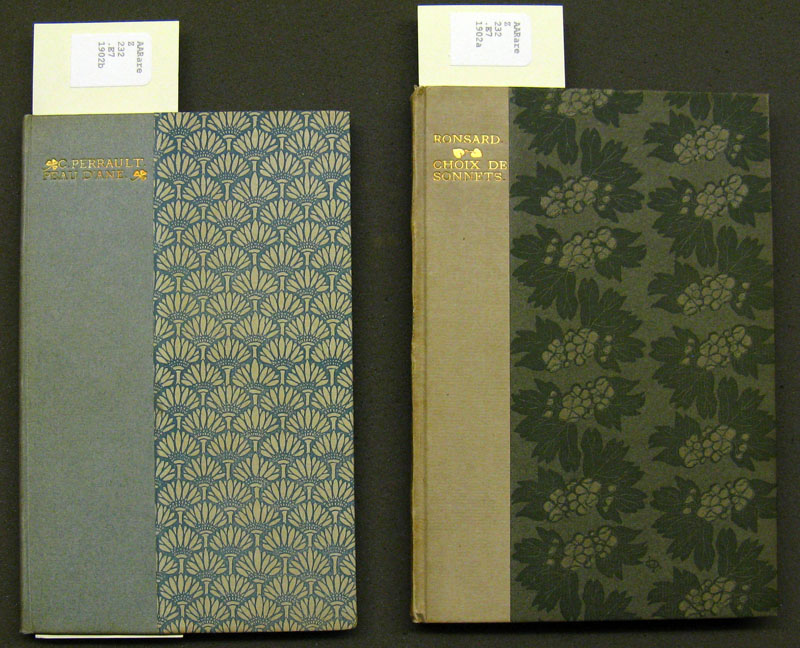
Two books from the Eragny Press, with their distinctive book covers.


The Eragny Press was run by Lucien Pissarro, son of the famous artist Camille Pissarro.  These books display a softer side to the fine-press works, especially in the use of illustration and the now-transformed border decorations from Morris' own style.

Although I use the class to emphasize the international growth of the fine press movement in the 1890's and beyond, I will close here with one more set of examples from England--Saint Dominic's Press.  This press was set up about 1920 (thus about a generation after Morris) as an offshoot of the Guild of Saint Joseph and Saint Dominic, a group of Catholic artisans and artists who broadened the audience for fine press books.  Among the more famous members of this group were Eric Gill (who later worked closely with the Golden Cockerel Press) and Hilary Pepler, who ran the St. Dominic's Press.

Pamphlets and a calendar printed by St. Dominic's Press.

A very large choir book (in Latin) of Christmas hymns, printed by the St. Dominic's Press.
A study in contrasts:  two examples of works from St. Dominic's Press.

Pepler and his colleagues often treated social issues along with religious topics in their publications.  Since many of their works were small, pamphlet-like articles, their works were available to a broader audience.  Gill eventually had a falling-out with Pepler and left, and later Pepler himself was asked to leave. But the guild continued for many years after their departures.

Many of the artists who started during the height of the fine-press movement--Bruce Rogers, W.A. Dwiggins, Frederic Goudy--later became major figures in the design of type, typography and book design in the first half of the twentieth century.  Perhaps we'll hear about them another time ...


Monday, February 6, 2012

Weeding or Reading?


Note: the following piece originally appeared in the HMML Chronicle in 2011. I am reproducing it here for those who may have missed it the first time.

Librarians often face the limits of tight budgets, inadequate space, and a shortage of personnel. So it is that the general rule of libraries is to keep only enough copies of any individual book for the regular use of readers, and HMML staff must also “weed out” duplicates occasionally as part of good stewardship practices. After all, with the introduction of printing in the fifteenth century, European books were “mass produced” and one copy of an edition was essentially the same as another. Or was it?

In contrast, the Hill Museum & Manuscript Library makes photographic copies of manuscripts, because they are by definition (being “hand-written” books) each different from the other. Thus, if HMML has photographed scores of copies of the same text by a certain author, that is good, since the different copies may reveal different readings of the text, plus they provide information about the interest in and distribution of that text.


Three copies, three covers.

However, books printed in a single edition and that have emerged from a press are often considered to be the same and thus it is not necessary (or even desirable) to keep multiple copies. For printed texts, this may be true much of the time. However, even in the course of printing an edition the proofreaders may find errors in the typesetter’s work and force the printing staff to make changes. Rather than destroy pages that had already been printed, printers would often make the changes and continue printing. At the same time, the sheets had to be printed on both sides, and if the proofreaders and pressmen made corrections in the text at different points in the process, then the sheets themselves might vary somewhat from one copy to another. In many other cases, corrections were made through a list of corrigenda (items to be corrected by the reader) or even through the substitution of one leaf for another (i.e., one leaf would “cancel” another leaf). Thus, there were multiple ways that even the text within an edition printed before 1800 might vary from one copy to another.

However, that is only true for the text itself. What about the book?

The Hill Museum & Manuscript Library is steward to approximately 10,000 rare books, spread over three different collections. Occasionally we find “duplicates” in the collections. One example lies in a devotional work by Francis Coster (or Frans de Costere, Franciscus Costerus, etc.)— his De Vita et Laudibus Deiparae Mariae Virginis Meditationes which appeared in numerous editions in the late sixteenth and early seventeenth centuries. This edition, published in Ingolstadt by David Sartorius in 1588, combines meditations on the Blessed Virgin Mary with a second collection of meditations on the Passion of Jesus. This divides the book into two volumes, with a second title page for the Passion meditations at p. 444. The Saint John's Rare Book Collection includes three copies of this edition. When one locates these items on the shelf, however, one is first struck by their different appearances.


The author

Francis Coster (1532-1619) was an early leader of the Jesuits. Born in Mecheln (Belgium) and accepted into the Jesuit order by Ignatius of Loyola himself on November 7, 1552, Coster spent most of his career in Belgium, Germany (Cologne) and in Rome. Coster established his reputation as one of the Catholic “controversial” theologians who challenged Protestant writers in the latter half of the sixteenth century. At the same time, as a fervent follower of the Virgin Mary, he promoted the work of Marian sodalities in Germany and Belgium and it was for these Catholic devotional communities that he composed his fifty Meditationes. Coster’s meditations on the Passion in volume two of this edition were also printed in English at Douai (France) in 1616. An important bibliography of Jesuit writers attributes forty-two titles to Coster, many of which countered Protestant publications. Indeed, the publisher of the 1588 edition—David Sartorius—was from a generation of printers in Ingolstadt, Dillingen and Augsburg, Germany, that produced many Jesuit works supporting the efforts of the Catholic “Counter-Reformation” in Central Europe.


Neighbors on the shelf.

The “Book” (or its cover)

In the so-called hand-press period (ca. 1450-1800), even printed books are still unique in some way, especially in their bindings. Only in the nineteenth century did publishers begin to issue their books already bound in a uniform manner for sale to the public. Before 1800, all books were bound by hand, individually, and according to the wishes of the person or institution purchasing the “book.” Depending upon the wishes (or wealth) of the buyer, the book might be bound in calfskin, goatskin, pigskin, or some other commonly available and durable material. In some cases, a copy of a book might never be sold, and thus might remain in storage, as folded, unbound sheets. For example, HMML has two copies of a very large 1732 chronicle of Göttweig Abbey (Austria)—one bound in the nineteenth century in two volumes. The other copy, a recent gift to HMML, has never been bound and is still in loose folded sheets and leaves of plates, as it would have been when it was first published 279 years ago. It is a little like those old “do-it-yourself” kits that enabled people to build their own radio, only in this case one is building a book! But let’s get back to Coster.

HMML’s three copies of Coster’s work are all quite small (from 4 1/8 inches to 4 ¾ inches tall). Of the edition’s more than 821 pages, 443 are dedicated to the Virgin and the remainder to the Passion. One curiosity is the pagination pattern, which changes slightly with volume two, so that the second half of the book deviates from common pagination practice by placing even numbers on the front side of each leaf.

All three copies have contemporary bindings that likely date to the late sixteenth century. Copy 1 is bound in stamped brown leather over wooden boards, with remnants of gilding in the decoration. One clasp (of an original two) remains. The edges of the leaves are stained a simple blue. Other than in its short, squat stature, copy 2 does not look like its “twin.” This copy has a soft vellum binding with decoration pressed into it.


Decoration on front cover of copy 2.


Edge decoration on copy 2.

Of particular interest is the decoration on the edge of the leaves that sets this copy apart as a “nicer” copy. Rather than clasps, this copy appears to have once had ties that are no longer extant. Remnants of a handwritten shelving label can still be found on the spine.

The final copy of Coster’s work deviates even further from the other two. Copy 3 was apparently bound in two pieces, of which HMML has only volume one (pages 1-443). Like so many other books from German monastic libraries in the HMML collections, this one is bound in blind-stamped pigskin over wooden boards. Although the pigskin is stained and discolored from use and age, it still shows remnants of the protective clasps. Like copy 1, this copy has simple, blue-stained edges on the leaves.


Three copies of the same "book" but with different results.

So, we have three copies with completely different bindings, made for three different “customers.” Indeed, it is this lesson of provenance that deepens interest in these three items as books, rather than mere texts. It seems likely that all three books came as part of a large gift from the Monastery of Ottobeuren in Bavaria in 1877. Two have explicit ownership notes from Ottobeuren (copies 1 and 2) and copy 3’s pigskin binding is similar to most books that came in that gift. The main title page bears a simple woodcut of the Virgin and Infant distributing gifts to the faithful. However, their stories seem to diverge from there.

The books from Ottobeuren almost always bear an ownership note on the title page, which stands alone on copy 1, but which is accompanied by other ownership notes on copy 2. It appears that copy 2 belonged to someone else before it came to Ottobeuren. Copy 3, which lacks its title page, probably belonged to one of the monasteries closed in the early nineteenth century by the Bavarian King. Such books often lost their title pages, perhaps as a way to make it more difficult for such institutions to try later to reclaim their lost property.

Three copies– three different stories in the title pages. Copy 1 (below) has a simple ownership note from the Monastery of Ottobeuren (“Ad usum Fratribus Ottenpuriensis”); while copy 2 has multiple ownership notes (including Ottobeuren); and copy 3 has no title page at all, only a later handwritten identification on the inside cover.


Ownership note in copy 3.

An ownership note does appear in copy 3, but it does not appear to be from the Monastery of Ottobeuren, but rather (and more likely) from a member of the type of Marian sodality for which Coster composed his meditations.

Finally, we come to the question of the reception of the work. Rare book librarians have shifted their approach to books as containers of texts alone to containers of stories (or perhaps: containers as stories). For example, one Latin-Greek New Testament in the Saint John’s collection was earlier described as uninteresting because a previous owner had bound-in blank sheets for taking notes (“interleaving”). In the late 1980’s, when this book was donated to Saint John’s, the librarian expressed dissatisfaction that the owner had defaced a nice eighteenth-century book this way. Today, however, librarians and scholars are equally interested in the history of the individual book and in its scholarly reception. Sometimes, just finger smudges on the leaves can tell the story of a book’s popularity (or lack thereof) or how it was used (or wasn’t). Catalogers are now asked to provide information about what makes their copy of an incunable (or book printed in the fifteenth century) different from other copies from the same edition, rather than re-constructing an ideal copy of that edition. Other than the different bindings, can we find evidence of reception in our three copies of the Meditationes?

While the text pages of the three Coster copies are largely unmarked, one small change made on the title page of copy 1 indicates a slightly less than reverent view of Marian devotion. At some point in the last 423 years, someone saw fit to make alterations to the pious scene of Mary and Jesus dispensing gifts. Unfortunately, the changes are undated.

What were they thinking ...


Copy 1.


Copy 2.


Thursday, January 26, 2012

Benedictines and their Books, part 2


From the title page of the Tyrocinium Benedictinum as copied in 1869
by the novice Bernard Locnikar, who later became the third abbot
of Saint John's Abbey in Collegeville, Minnesota.
From their very roots in a cave near Subiaco, Italy, Benedictines have been associated with reading and books. While the Rule of Benedict hardly mentions "books" per se, it does demand a great deal of reading in Benedictine communities. This was true even when they moved out here to Central Minnesota.  Not only did the transplanted Bavarian monks bring books with them, but they also actively made books themselves, especially as novices.


Saint John's has several manuscript copies of the Tyrocinium Benedictinum, a guide book and introduction to Benedictine life for monastic novices.  Each volume has a streamer in it with the name of the monk who copied the book and the year in which it was copied--the earliest is from 1845 and the last from the 1880's. In many cases the scribe has indicated that he copied the book during his novitiate at Saint Vincent's Abbey in Pennsylvania, the first Benedictine monastery in the United States.  Many of these novices at Saint Vincent's later came to Saint John's in Central Minnesota.

The Tyrocinium Benedictinum in the copy made by Conrad Glatzmaier, OSB, in 1878.


Conrad Glatzmaier's depiction of Saint Vincent's Abbey in 1878.


I sometimes ask visitors to the Hill Museum & Manuscript Library (especially college students) how they choose to be remembered. In face of the rapidly changing modes of communication and storage -- Facebook, Twitter, e-books, etc.--one sometimes wonders whether there will be a clear record of our presence in the future.  The latest technology rarely lasts more than 5 to 10 years.  I then show them one or two of the Tyrocinium copies and explain a little of what they are:  guidebooks to the Benedictine life that were hand-copied (in Latin, i.e., a foreign language!) by teenagers much like themselves, in a time that knew no computers, electric typewriters, photocopiers, scanners, or even ball-point pens!

At first I thought that the reason for copying this book was merely pedagogical--if you copy out a text, you are likely to remember at least parts of it better. Only recently did it strike me that the earliest printed versions of this text first appeared in the 1890's (Latin in 1893 and English in 1996)! Thus, the copies in the Saint John's collections (all of which predate the 1890's) were copied at a time when no printed version existed. These Benedictine novices could not just wander down to the bookstore to buy a study-edition of the Tyrocinium (much less download it into their tablet or e-book reader), they had no recourse but to make their own copy!

 
1896 English translation
(as Tyrocinium Religiosum).
1894 Latin edition of the Tyrocinium.

The novices were allowed to decorate their own copy in an appropriate manner.  Here are some examples from the copy made by Alexius Hoffmann, OSB, in 1880 (when he was 17 years old). Hoffmann would later become prominent as the historian of Saint John's University and Abbey, as well as the author of a guide to student life at Saint John's that was frequently reprinted.


Indeed, most of the copies of the Tyrocinium are not so well-decorated, and the handwriting is often rather inelegant (to say the least), but even with these, the centuries-old tradition of copying (and correcting) a text is consistently applied.

Copy of the Tyrocinium that once belonged to Bishop Martin Marty,
 copied in 1845 (possibly in Europe?).
Note the corrections to the text (e.g.: "Man(u)ductio").
The monks copied other books, as well. One quick example is a Vesperale (or songbook for vespers) that was copied in 1864-1865 by Alexius Edelbrock, OSB, who later became the second abbot of Saint John's Abbey.


As crude as the copying is, it provided a means for Frater Alexius to participate in the prayer life of the community. He would have been about 19-20 years old when he was copying this book out. Note that the lines on the paper are perpendicular to the music and text.

So, manuscript culture continued in the monastery up to the end of the 19th-century.  Reading (and Benedict instructed his followers to read) required books, books that were not always readily available.  As part of a life dedicated to prayer and work, the copying of books combined both sides of Benedictine life--prayerful reading tied to prayerful work.

Oh, by the way, the Hill Museum & Manuscript Library will soon put copies of the Latin and the English printed versions of the Tyrocinium Benedictinum in its online image collection, Vivarium (www.hmml.org/vivarium) as part of a growing set of Benedictine works, including early copies of the Rule of Benedict, pictorial lives of Benedict and other Benedictine saints, etc.  Perhaps some enterprising youth out there will take the opportunity to copy the Tyrocinium from there?

Cross of Benedict from Conrad Glatzmaier's 1880 copy of the Tyrocinium Benedictinum.

 UIOGD