Search This Blog

Thursday, January 26, 2012

Benedictines and their Books, part 2


From the title page of the Tyrocinium Benedictinum as copied in 1869
by the novice Bernard Locnikar, who later became the third abbot
of Saint John's Abbey in Collegeville, Minnesota.
From their very roots in a cave near Subiaco, Italy, Benedictines have been associated with reading and books. While the Rule of Benedict hardly mentions "books" per se, it does demand a great deal of reading in Benedictine communities. This was true even when they moved out here to Central Minnesota.  Not only did the transplanted Bavarian monks bring books with them, but they also actively made books themselves, especially as novices.


Saint John's has several manuscript copies of the Tyrocinium Benedictinum, a guide book and introduction to Benedictine life for monastic novices.  Each volume has a streamer in it with the name of the monk who copied the book and the year in which it was copied--the earliest is from 1845 and the last from the 1880's. In many cases the scribe has indicated that he copied the book during his novitiate at Saint Vincent's Abbey in Pennsylvania, the first Benedictine monastery in the United States.  Many of these novices at Saint Vincent's later came to Saint John's in Central Minnesota.

The Tyrocinium Benedictinum in the copy made by Conrad Glatzmaier, OSB, in 1878.


Conrad Glatzmaier's depiction of Saint Vincent's Abbey in 1878.


I sometimes ask visitors to the Hill Museum & Manuscript Library (especially college students) how they choose to be remembered. In face of the rapidly changing modes of communication and storage -- Facebook, Twitter, e-books, etc.--one sometimes wonders whether there will be a clear record of our presence in the future.  The latest technology rarely lasts more than 5 to 10 years.  I then show them one or two of the Tyrocinium copies and explain a little of what they are:  guidebooks to the Benedictine life that were hand-copied (in Latin, i.e., a foreign language!) by teenagers much like themselves, in a time that knew no computers, electric typewriters, photocopiers, scanners, or even ball-point pens!

At first I thought that the reason for copying this book was merely pedagogical--if you copy out a text, you are likely to remember at least parts of it better. Only recently did it strike me that the earliest printed versions of this text first appeared in the 1890's (Latin in 1893 and English in 1996)! Thus, the copies in the Saint John's collections (all of which predate the 1890's) were copied at a time when no printed version existed. These Benedictine novices could not just wander down to the bookstore to buy a study-edition of the Tyrocinium (much less download it into their tablet or e-book reader), they had no recourse but to make their own copy!

 
1896 English translation
(as Tyrocinium Religiosum).
1894 Latin edition of the Tyrocinium.

The novices were allowed to decorate their own copy in an appropriate manner.  Here are some examples from the copy made by Alexius Hoffmann, OSB, in 1880 (when he was 17 years old). Hoffmann would later become prominent as the historian of Saint John's University and Abbey, as well as the author of a guide to student life at Saint John's that was frequently reprinted.


Indeed, most of the copies of the Tyrocinium are not so well-decorated, and the handwriting is often rather inelegant (to say the least), but even with these, the centuries-old tradition of copying (and correcting) a text is consistently applied.

Copy of the Tyrocinium that once belonged to Bishop Martin Marty,
 copied in 1845 (possibly in Europe?).
Note the corrections to the text (e.g.: "Man(u)ductio").
The monks copied other books, as well. One quick example is a Vesperale (or songbook for vespers) that was copied in 1864-1865 by Alexius Edelbrock, OSB, who later became the second abbot of Saint John's Abbey.


As crude as the copying is, it provided a means for Frater Alexius to participate in the prayer life of the community. He would have been about 19-20 years old when he was copying this book out. Note that the lines on the paper are perpendicular to the music and text.

So, manuscript culture continued in the monastery up to the end of the 19th-century.  Reading (and Benedict instructed his followers to read) required books, books that were not always readily available.  As part of a life dedicated to prayer and work, the copying of books combined both sides of Benedictine life--prayerful reading tied to prayerful work.

Oh, by the way, the Hill Museum & Manuscript Library will soon put copies of the Latin and the English printed versions of the Tyrocinium Benedictinum in its online image collection, Vivarium (www.hmml.org/vivarium) as part of a growing set of Benedictine works, including early copies of the Rule of Benedict, pictorial lives of Benedict and other Benedictine saints, etc.  Perhaps some enterprising youth out there will take the opportunity to copy the Tyrocinium from there?

Cross of Benedict from Conrad Glatzmaier's 1880 copy of the Tyrocinium Benedictinum.

 UIOGD


Wednesday, January 18, 2012

Smell this book ...


[aside: my apologies for the inconsistent photographs in this posting - the images come from several sources! Clicking on any image will open up a slideshow of the pictures in this posting.] 

One of the primary lessons rare book librarians seek to share with visitors is the idea that books exist not only as items of themselves--as a container for text, as a physical artifact, or even as a work of art. A book can be all of these things, but beyond all this, a book is an historical record in itself.  Among my favorite examples in our collection is a facsimile of the Darmstadt Haggadah.  In the true fashion of a book telling a story beyond the text it contains, grease stains in the corners provide an opportunity to show students (and faculty) how books tell the story of storytelling (of Passover), if we only read the signs. But I think I will save that story for another day.


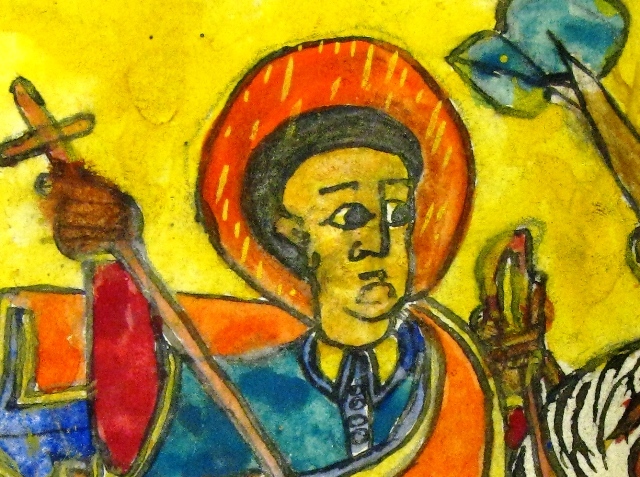
Instead, today I would like to talk a little about the Ethiopian manuscript collection at the Hill Museum & Manuscript Library.  Ethiopian manuscripts in Central Minnesota? Yes, indeed!  As many know, HMML started as a microfilming project in Austria in 1965.  Today the library has over 90,000 microfilms of medieval and early modern manuscripts from across Europe and Africa, along with a growing number of digitized manuscripts from the Middle East, Ethiopia, the Ukraine, and India. Over the last 47 years HMML has accumulated one of the largest collections of copies of Ethiopian manuscripts in the world. True to its calling, HMML has not purchased manuscripts, but has copied these with cameras in situ.

At the same time, through the work of Dr. William Macomber and Dr. Getatchew Haile, HMML became famous for the scholarship dedicated to cataloging these manuscript copies.  Their scholarly work (including a 10-volume catalog of the microfilms) has, in a sense, given the impetus for numerous gifts of Ethiopian manuscripts to the library.  Last year I compiled an inventory of the Ethiopian manuscripts at HMML and found that the library has 30 manuscripts--16 codices and 14 prayer scrolls--spread across three collections.


Among the codex manuscripts in the collection is one that is often referred to as "the hairy book" and another "the smoky book."  The latter is a 17th-century Psalter--extremely fragile, with a binding that is completely loose.  We store it in a sturdy clam-shell box.  Officially, this manuscript is known as Franklin H. Williams ms. 1, named after the donor.
"The hairy book"

My colleagues have gotten into teasing me about the tagline, "Smell this book!"  The line is heard whenever a group of students comes to the library to learn about books, book preservation and book history.  The immediate reaction is always a mixture of curiosity from some, and fear from others-- 
Student: "Is it gross?"
Librarian: "No, I don't do gross."
Student: "I don't think so."
Librarian: "Anyone else?"
Other Student: "Sure, I'll try it ..."
When someone finally musters up courage to smell the Psalter, they quickly recognize the familiar smell of campfire, or at least a smell similar to that.  I then proceed to explain that in Ethiopia, manuscript culture has remained vibrant, even into the modern era.  Thus, manuscripts continue to be used for prayer, instruction, liturgy, and other aspects of Christian life in Ethiopia.  What does this have to do with smoke?  Well, many places of worship in Ethiopia are in locations that have no electricity and no central heating.  This Psalter has collected the smells of open fire and burning candles over the course of more than three centuries. Its stained pages (and fragile binding) show how heavily it was used for prayer during that time. While this book no longer has a carrying pouch, many of our Ethiopian manuscripts still have pouches for convenient use whenever and wherever the time for prayer occurs.


As with the grease stains in the Darmstadt Haggadah, the smoke in Franklin H. Williams Ms. 1 tells a story of the priests who used this manuscript, where it was used, how it was used, and how important it has been to the spiritual life of several people over the centuries. It is a story that, alas, digital images cannot yet impart--only the original manuscript opens up this side of history for us.

Wednesday, January 11, 2012

Beginnings of a Collection; or, Starting at Number One


From the Revelation in the 1572 edition of
Johann Dietenberger's translation
of the Bible into German.
(This article originally appeared in a predecessor blog on the HMML website. I am reproducing it here for those who may have missed it the first time it appeared in 2009.)

In 1875, Father Bernard Locnickar, O.S.B., began a handwritten record of the books in the Abbey library at what is today Saint John’s Abbey and Saint John’s University. First among the books recorded was a 1572 copy of the Bible, translated into German by Johann Dietenberger (Zu Cöln / Durch Gerwinum Calenium und die Erben etwan Johan Quentels / Im Jar M.D.LXXII.). Father Bernard’s 1875 “catalog” provides a snapshot of an already existing collection about whose earliest history very little is known.


While it seems unthinkable that the monks travelling to Central Minnesota in 1856 would not have brought at least one Bible, a copy of the Rule of Benedict and liturgical books like missals and breviaries, there is no record to verify this. Ronald Roloff, O.S.B., in his 1953 history of the Abbey library could only point to early course catalogs and speculate that individual monks probably had personal libraries to use for worship and teaching. Already in 1869 and 1870 there were beginnings of student libraries at Saint John’s, but still no official Abbey or College library.

Thus, Father Bernard’s 1875 record marks the beginnings of a formal library as we understand it. It is a fascinating document in many ways, with sparse entries for the books and (sometimes) maddeningly minimal information on their acquisition. The location of each book is given with a shorthand notation that seems meaningless without the key in the front flyleaf.
The first page of the first accessions book from Saint John's Abbey and University,
showing the entry for Dietenberger's German Bible (1572).

The first 75 books recorded were all either Bibles, biblical texts or works about the Bible. Of these, the largest number were in German, Latin, or both. However, there were also Bibles in Hebrew, Greek, and of course, English. Most likely, the Bible chosen to be number one in the catalog had a special significance for the monastic community at Saint John’s, but that story seems to have disappeared over the decades. Other topics in the earliest books collected include homiletics, catechisms, moral and dogmatic theology, and apologetics. Many of these books form the core of the Special Collections at Saint John’s today.

The 1572 edition of Dietenberger’s Bible translation is a good example. It was originally published in 1534 as a Catholic response to Martin Luther’s complete Bible translation which appeared that same year. The Saint John’s copy is from the 8th edition and features woodcut decorations on the title pages for both the Old and New Testament. The woodcuts feature the Holy Trinity at the top, as well as the four Evangelists along the sides and the twelve apostles at the bottom. The volume includes several woodcuts and historiated initials.

What is most touching about this Bible, however, is that it is not in pristine condition! Many pages are damaged around the edges, some are water-stained, some pages are loose. The binding is very plain and worn. But all the damage bespeaks a volume that at one time was used heavily and not set aside as an untouchable jewel. Books have always been central to the spiritual life of the Benedictines, and this book—printed in 1572 in Germany and lovingly recorded in 1875 in Minnesota—appears to have earned its honorary title of number one (“Nro: 1”).


The opening of the Book of Genesis in the 1572 edition
of Johann Dietenberger's German translation of the Bible
("Im Anfang hat Gott geschaffen himel un(d) erden.")

Thursday, January 5, 2012

Scrapbooks or scrapping books? More Manna from the Basement


My daughter recently hit upon the idea of making her own book where she could keep items of interest and pictures that she finds interesting. Gathering up an unused binder, some sheets of colored paper, a couple photos, and some ink markers, she set to work.

Click on any picture in this article to see it enlarged.

Back of a World War II poster
in the HMML collections.
Drolleries in Bean Ms. 3.
The idea of creating a scrapbook is nothing new--it's been done for centuries. In a way, the commonplace books and miscellanies of the late Middle Ages and Early Modern period are a form of scrapbook, even if the contents are not cut out of other books or publications--they all represent the accumulation of varied materials that interested the book's owner.  Some of the Early Modern manuscripts in the HMML collections combine German script (mostly prayers or devotional texts) with printed plates glued into the volume.  But what happens when the visual trumps the textual? If all that interests you is the "look" of the item and not the contents of the text, then scrapbooking can take a different turn.


Album of 16th-century
printing examples.
 In the nineteenth century, some people enjoyed the activity of cutting up old manuscripts and books for their artwork. Even the famous art critic, John Ruskin, has gained notoriety for his treatment of medieval books:

"Whatever Ruskin possessed, he desired to share. This desire, and the free scope he gave to it, saved him effectually from "getting to be a mere collector.'" His books, he used to say, were "for use and not for curiosities." He treated them in a way which can hardly be recommended for general practice. He annotated some of his most valuable manuscripts not merely in pencil, but in ink. He cut them to pieces, re-arranged them to his own desire, and of the St. Louis Psalter he dispersed many of the pages. Some were given to his school at Oxford; others found their way to the Bodleian Library; and others were given to his friend, Professor Norton. Some entries in his diary may well cause "a mere collector" to despair:—"Dec. 30, 1853.—Cut out some leaves from large missal." "Jan. 1, Sunday.—Put two pages of missal in frames." "Jan. 8. —Cut missal up in evening; hard work." (From vol. 12 of The Works of John Ruskin, ed. E.T. Cook and Alexander Wedderburn, London, 1904, pp. lxix-lxx; see Google Books for the entire text.)

Page from an unprocessed
scrapbook collection.
The Hill Museum & Manuscript Library (HMML; http://www.hmml.org/) also has examples of scrapbooks.  Sometimes these become known to us through what I call the "manna experience"; i.e., when one finds an unidentified item in the collection and can only ask, "what is it?"

One day this week I spent about two hours looking through ten boxes of scrapbooks that were probably compiled in the 1930's or 1940's by an aspiring art student.  The books, all very grimy and some with clear signs of water damage and mold, have been in the backlog of uncataloged materials that came with the Arca Artium collection at HMML.  The vast content of the scrapbook collection consisted of pictures and articles from art journals and picture magazines (like Life or Look), but the very last box included one volume of original studies, another volume that included some early prints, and a World War II poster.


After some further investigating, it became clear that this collection probably was compiled by Christian Andersen, an art student in Minneapolis, Minnesota, in the 1930's or 1940's.  Unfortunately, the trail here breaks off--for now at least.

Another recent "manna experience" was the discovery of an album with cuttings from sixteenth-century printed books, also from the Arca Artium collection.  Here is a sampling of pages from this volume:


Click on any image to see it enlarged or to see a slideshow of the pictures in this posting.

The clippings come from several different sources and represent some view to organizing the contents--some pages contain all initials, some contain all borders or decorative woodcuts, some contain title pages, and some contain only pictures from one particular book.  As such, this volume (which has been described by one person as a sort of "clip-art" book) represents the interests of one particular individual, most likely someone living in the 19th century.  The Library has photographed the entire volume and will soon put these photographs into its online image collection, Vivarium (www.hmml.org/vivarium). For a librarian, like myself, this album poses the challenge to identify the various books from which these pictures and clippings came.  Such albums (or "new books") can be useful for teaching and study, not of a specific sixteenth-century work or text, but of the reception of books that had "outlived their usefulness" in the eyes of a later generation.
Other books that lost their usefulness over time were medieval liturgical books, especially as changes in liturgical practice and religious beliefs took place (see the anecdotes about John Ruskin above). My final example today from the HMML collections is a volume called "Bean Ms. 3" which is an album of clippings from thirteenth- and fourteenth-century manuscripts. The album includes several historiated and decorated initials, as well as drolleries and other decorative elements.  The entire manuscript can be viewed in Vivarium at http://cdm.csbsju.edu/u?/HMMLCollect,3563.  Here are some sample images:

Click on any image to enlarge it.
Thus, the records of the past come down to us in many forms, some of them more fragmentary than others--and some of them fragmentary through intent, not neglect.  In some cases, these scrapbooks may have actually saved the art they contain from oblivion, but in most cases they have probably effaced the past through destruction of the context in which this art was intended to be seen and consumed.
Fortunately, my daughter has not yet learned to cut up books, but she has already cut a picture that she liked, from a box.   For now, at least, let's keep the scissors and glue in plain sight ...