Search This Blog

Thursday, January 5, 2012

Scrapbooks or scrapping books? More Manna from the Basement


My daughter recently hit upon the idea of making her own book where she could keep items of interest and pictures that she finds interesting. Gathering up an unused binder, some sheets of colored paper, a couple photos, and some ink markers, she set to work.

Click on any picture in this article to see it enlarged.

Back of a World War II poster
in the HMML collections.
Drolleries in Bean Ms. 3.
The idea of creating a scrapbook is nothing new--it's been done for centuries. In a way, the commonplace books and miscellanies of the late Middle Ages and Early Modern period are a form of scrapbook, even if the contents are not cut out of other books or publications--they all represent the accumulation of varied materials that interested the book's owner.  Some of the Early Modern manuscripts in the HMML collections combine German script (mostly prayers or devotional texts) with printed plates glued into the volume.  But what happens when the visual trumps the textual? If all that interests you is the "look" of the item and not the contents of the text, then scrapbooking can take a different turn.


Album of 16th-century
printing examples.
 In the nineteenth century, some people enjoyed the activity of cutting up old manuscripts and books for their artwork. Even the famous art critic, John Ruskin, has gained notoriety for his treatment of medieval books:

"Whatever Ruskin possessed, he desired to share. This desire, and the free scope he gave to it, saved him effectually from "getting to be a mere collector.'" His books, he used to say, were "for use and not for curiosities." He treated them in a way which can hardly be recommended for general practice. He annotated some of his most valuable manuscripts not merely in pencil, but in ink. He cut them to pieces, re-arranged them to his own desire, and of the St. Louis Psalter he dispersed many of the pages. Some were given to his school at Oxford; others found their way to the Bodleian Library; and others were given to his friend, Professor Norton. Some entries in his diary may well cause "a mere collector" to despair:—"Dec. 30, 1853.—Cut out some leaves from large missal." "Jan. 1, Sunday.—Put two pages of missal in frames." "Jan. 8. —Cut missal up in evening; hard work." (From vol. 12 of The Works of John Ruskin, ed. E.T. Cook and Alexander Wedderburn, London, 1904, pp. lxix-lxx; see Google Books for the entire text.)

Page from an unprocessed
scrapbook collection.
The Hill Museum & Manuscript Library (HMML; http://www.hmml.org/) also has examples of scrapbooks.  Sometimes these become known to us through what I call the "manna experience"; i.e., when one finds an unidentified item in the collection and can only ask, "what is it?"

One day this week I spent about two hours looking through ten boxes of scrapbooks that were probably compiled in the 1930's or 1940's by an aspiring art student.  The books, all very grimy and some with clear signs of water damage and mold, have been in the backlog of uncataloged materials that came with the Arca Artium collection at HMML.  The vast content of the scrapbook collection consisted of pictures and articles from art journals and picture magazines (like Life or Look), but the very last box included one volume of original studies, another volume that included some early prints, and a World War II poster.


After some further investigating, it became clear that this collection probably was compiled by Christian Andersen, an art student in Minneapolis, Minnesota, in the 1930's or 1940's.  Unfortunately, the trail here breaks off--for now at least.

Another recent "manna experience" was the discovery of an album with cuttings from sixteenth-century printed books, also from the Arca Artium collection.  Here is a sampling of pages from this volume:


Click on any image to see it enlarged or to see a slideshow of the pictures in this posting.

The clippings come from several different sources and represent some view to organizing the contents--some pages contain all initials, some contain all borders or decorative woodcuts, some contain title pages, and some contain only pictures from one particular book.  As such, this volume (which has been described by one person as a sort of "clip-art" book) represents the interests of one particular individual, most likely someone living in the 19th century.  The Library has photographed the entire volume and will soon put these photographs into its online image collection, Vivarium (www.hmml.org/vivarium). For a librarian, like myself, this album poses the challenge to identify the various books from which these pictures and clippings came.  Such albums (or "new books") can be useful for teaching and study, not of a specific sixteenth-century work or text, but of the reception of books that had "outlived their usefulness" in the eyes of a later generation.
Other books that lost their usefulness over time were medieval liturgical books, especially as changes in liturgical practice and religious beliefs took place (see the anecdotes about John Ruskin above). My final example today from the HMML collections is a volume called "Bean Ms. 3" which is an album of clippings from thirteenth- and fourteenth-century manuscripts. The album includes several historiated and decorated initials, as well as drolleries and other decorative elements.  The entire manuscript can be viewed in Vivarium at http://cdm.csbsju.edu/u?/HMMLCollect,3563.  Here are some sample images:

Click on any image to enlarge it.
Thus, the records of the past come down to us in many forms, some of them more fragmentary than others--and some of them fragmentary through intent, not neglect.  In some cases, these scrapbooks may have actually saved the art they contain from oblivion, but in most cases they have probably effaced the past through destruction of the context in which this art was intended to be seen and consumed.
Fortunately, my daughter has not yet learned to cut up books, but she has already cut a picture that she liked, from a box.   For now, at least, let's keep the scissors and glue in plain sight ...

Wednesday, December 28, 2011

Penmanship before the (ballpoint) pen ...

In recent news stories we read that many consider the teaching of cursive writing to be passé. After all, no one actually writes anymore. Today's discipline leans towards the acquisition of keyboard skills, not pen skills, and children are expected to learn the layout of the keys at an early age.


Title page of Compendio del gran volvme dell'art del bene & leggiadramente scriuere tutte le forti di lettere e caratteri (Venetia: Appresso Aluise Sessa, 1588).

Of course this was not true in earlier ages, when writers and scribes used quills, pens (ballpoint and otherwise), pencils, crayons, lumps of charcoal, etc., for communicating their ideas. Handwriting of some sort has been a vital mode of communication across all societies and cultures since the first use of cuneiform in the third millenium B.C.E. The Hill Museum & Manuscript Library focuses especially on the preservation of written materials, as well as teaching of basic skills to undertake research with these materials.  To that end, the Library has acquired a large collection of books on handwriting over the past few decades, with works in most western European languages, as well as several works on written languages elsewhere in the world.


Tools for handwriting from the Compendio.
 In today's post we find four examples of early books dedicated to the teaching of proper handwriting from the HMML collections.  These books were digitally photographed over the summer of 2011 as part of a larger project to make HMML resources available worldwide through its online image collection, Vivarium (www.hmml.org/vivarium).  These books are not yet in Vivarium, but will be soon.

At the same time, HMML is preparing these books for presentation in its online manuscript studies reference library, which will be available at: http://manuscriptstudies.pbworks.com/w/page/48672053/Library. Check back periodically to see how we are doing.

Note that some of the writing samples were prepared from woodcuts and others from metal plates.  Often those from metal plates became so "flourished" that the text got lost under the flourishes! Later such "facsimiles" were produced with lithography, chromolithography, photography, and now digital photographs. But interest in studying and teaching handwriting (and penmanship) date back at least to the sixteenth century.


 To see any of the images below in large size and to view a slide show of the pictures, click on an image.


The author of the Compendio, Giovanni Battista Palatino.

A sixteenth-century rebus in Italian, from the Compendio.

A close-up of the rebus - the first line starts: "Dove son ..."


Hebrew characters in the Compendio.

Other character sets and alphabets, including Ethiopic.
Title page from Johann Gottfried Weber's Allgemeine Anweisung der neuesten Schönschreibkunst (Duisburg am Rhein, [1780]).

From the Allgemeine Anweisung: "Bemühe dich eine deutliche, gründliche und vollständige Erkenntniss deiner Pflichten zu erlangen." [i.e., Endeavor to achieve a clear, fundamental and complete understanding of your duties. -- of course, first you must be able to read this instruction in order to follow it ...]

How to cut your quill and hold it properly. From the Allgemeine Anweisung.
 

More elaborate writing examples from the Allgemeine Anweisung.


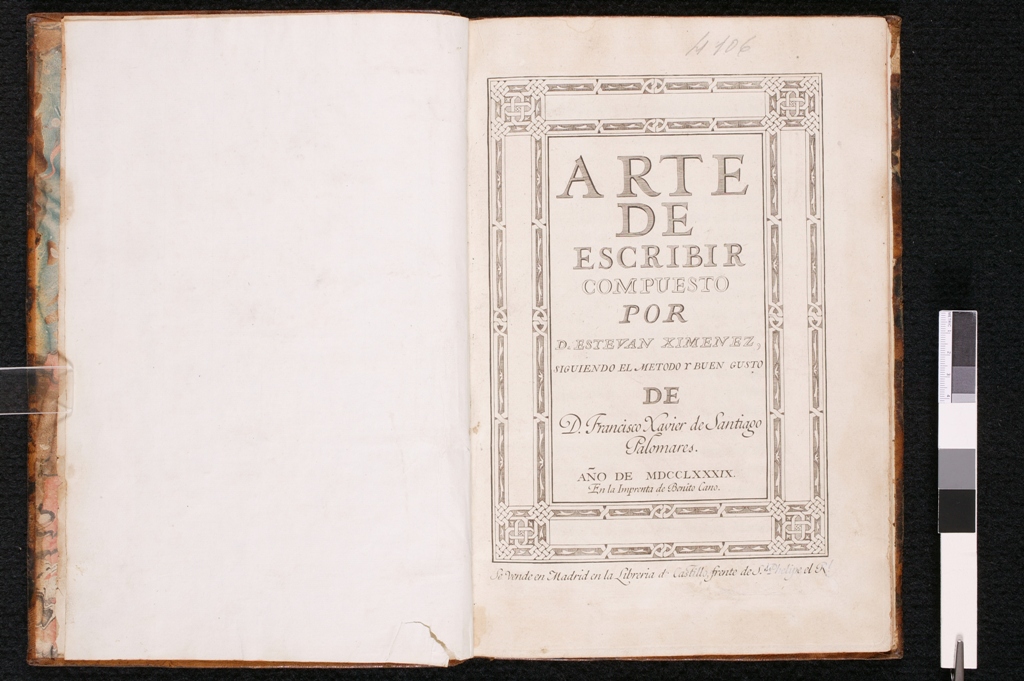
The Arte de Escribir, by Francisco Javier de Santiago Palomares (Madrid, 1789).

A grid pattern from the Arte de Escribir, demonstrating the proper angle of the letters.

More instructions on posture from the Arte de Escribir.
Court Hand Restored, by Andrew Wright (London: Printed for Benjamin White, 1776).


Examples of English court hands, from Court Hand Restored.

Examples of common written abbreviations from Court Hand Restored.
Examples of "running Courthand," from Court Hand Restored.

Finally, a reading test for those who have studied the previous images.

 Sic transit scriptura!

Tuesday, December 20, 2011

Christmas Comes But Once a Year (but Christmas books hang around)


Those who make books generally do so because they love sharing their books with others.  This is certainly true for printers and publishers who have produced "Christmas books" over the years.  These books are not necessarily books about Santa and reindeer, nor are they do they focus ghosts of Christmasses past, present or future.  No, these Christmas books are special publications made at Christmastime to share with friends and clients of the publishing house.  Thus, these books are usually printed in smaller numbers and most are set aside in advance as gifts, not as commercial products.  As such, they often give us a small taste of what a publishers/printers/designers consider in their work to be the best, most playful, or spiritually meaningful.
 
Some of the numerous Christmas books designed by Frank Kacmarcik, Obl.S.B., and published by Al Muellerleile at North Central Publishing.

The Hill Museum & Manuscript Library has a large collection of such Christmas books from a Twin Cities (Minnesota) printing house: North Central Publishing, led by Al Muellerleile (1908-1985). Mr. Muellerleile was long a friend of Saint John's University, and a number of the books in our Special Collections were donated by him. Beyond that, however, Al Muellerleile was a good friend of Frank Kacmarcik (1920-2004), a book artist, liturgical artist, graphic designer, and consultant for liturgical spaces.  Together, they produced annual Christmas books from the late 1940's into the early 1980's.  Below are a few examples of the books they produced. 


Click on any image below to see it enlarged.


The Birth of the Lord Jesus Christ (based on Matthew and Luke), with designs by Frank Kacmarcik.

Title page of  A Nativity Sequence (1954).

The Magi bring their gifts to the Christ Child in Frank Kacmarcik's rendition.
Seasons of Hope - an appropriate title at Christmastime.

The colophon of one of the Christmas books, with the NCP monogram (North Central Publishing), listing the artists involved in the project, and specifying the number of copies made and the specific number of this copy.

The North Central Christmas books included more than just retellings of the Nativity.  There were also stories or poems by Vincent Arthur Yzermans, Eugene McCarthy, Pope John XXIII, Pope John Paul II, Saint Ephrem, and Al Muellerleile, himself!


A title by Pope John Paul II from early in his papacy.

Cover design by Frank Kacmarcik.

In general, North Central Publishing produced 1200 copies of these books, so it is no surprise that not all of them were promptly given away.  When Frank Kacmarcik donated his collections of art, rare books and reference books (the "Arca Artium Collection") to Saint John's University, he included many copies of each of these books.  To learn more about his art collection, look for "Arca Artium" in Vivarium, and for his book collections, look for "Arca Artium" in MnPALS.

Life of Saint Benedict, based on a 16th-century pictorial biography.

Pages from the life of Benedict, showing his early conflicts with monastic communities at Subiaco.

HMML takes care of a great many other Christmas books in the Saint John's Special Collections, but no other series of special Christmas books is so well represented as the North Central books.  These, and all the books in Saint John's Special Collections, are available for viewing on request.  Feel free to contact HMML or the author of this article if you wish to learn more about the Library's collections.

May this Christmas season bring peace and joy to all!

Wednesday, December 14, 2011

Finding your way home (sort of ...)

On Monday, December 12, 2011, an English class from Saint John's University and the College of Saint Benedict visited the Hill Museum & Manuscript Library to see books and facsimiles relating to the early modern age of explorations, the Caribbean region and the Americas.  Over 20 students and their professor crowded into the small classroom at HMML to hear about preserving manuscripts and rare books, about the history of books, and to see up close items from the research collections. 

Among the items on display were histories of Jamaica and the West Indies from the late 18th century, as well as facsimiles of a 15th-century world map, books by Christopher Columbus, and the 1494 treaty between Spain and Portugal to divide up the New World.  Among the printed books was a large atlas printed in France in the years 1776-1784, the Atlas Universel, as well as a 1537 collection of accounts of explorations of the New World (the Novus Orbis Regionum ac Insularum).  These materials gave the students a chance to see up close the European view of the world in a medieval context, an early modern context and a colonial context.  The Atlas shows a North America in which there is no such thing as the "Midwest," only a region called Louisiana, where primarily rivers and lakes are identified.  Many of the names are familiar to us still today--Lake Michigan or Lake Superior, the Missi-sipi or the Saint Joseph River in southern Michigan and northern Indiana (where I grew up a couple blocks from the river).  It even includes a mark for a place called "Chicagon" at the southern tip of Lake Michigan.

The students had the chance to hear both from a library representative about the research collections at HMML (i.e., from me), as well as from their professor, who could place the items into a context of his own research interests.  Studying the language, literature and culture of England and the United States in a pre-industrial revolution world incorporates many other resources as well.

In addition to the class visit, however, HMML staff is supporting the use of these materials by the class through a Wiki that the Library has set up to include bibliographies, teaching notes, and pictures of materials used--http://hmmlrarebooks.pbworks.com/w/page/48437083/Caribbean%20Culture.  Who knows what else we might find to put in there?

Here are more samples from the presentation. Click on an image to see it enlarged.