Search This Blog

Friday, April 20, 2012

Lacking directions but following clues, or, CSI Special Collections

So what does she know about this book that I don't?
From Joseph Neusinger's Papatus nunquam errans in proponendis fidei articulis
(Augustae [Augsburg]: Typis Joannis Michaelis Labhart, 1709).

Cataloging rare books and manuscripts can be a lot of fun--most of the time.  There are occasions when one wants to throw one's hands in the air and cry "alas and alack" (or in this case, perhaps "alas and a lack," but more on this below).


Today I am going back to some of the many "problem" titles that are left from a big cataloging project that our library undertook in the years 2004-2008. The Hill Museum & Manuscript Library is responsible for a collection of about 10,000 rare book titles, spread across three different sub-collections. When we started a Mellon Foundation-funded cataloging project in 2004, about 1100 of these titles had been cataloged. The rest had either 1) never been cataloged (but listed in a short-title catalog), 2) cataloged on paper in Dewey classification; 3) cataloged on paper in Library of Congress classification, or 4) none of the above.

Initial from an uncataloged 1514 Basel edition of the Plenarium, or collection of pericopes in German.
  
After four years, we had added about 8400 or 8500 rare titles to our online catalog.  Since 2008, I have been cataloging little pockets of materials as I have identified them or as I have found spare time (please don't tell my boss about finding spare time ...) to spend researching incomplete items.  It is some of these incomplete volumes (hence the "lack" mentioned above) that I wish to discuss today.

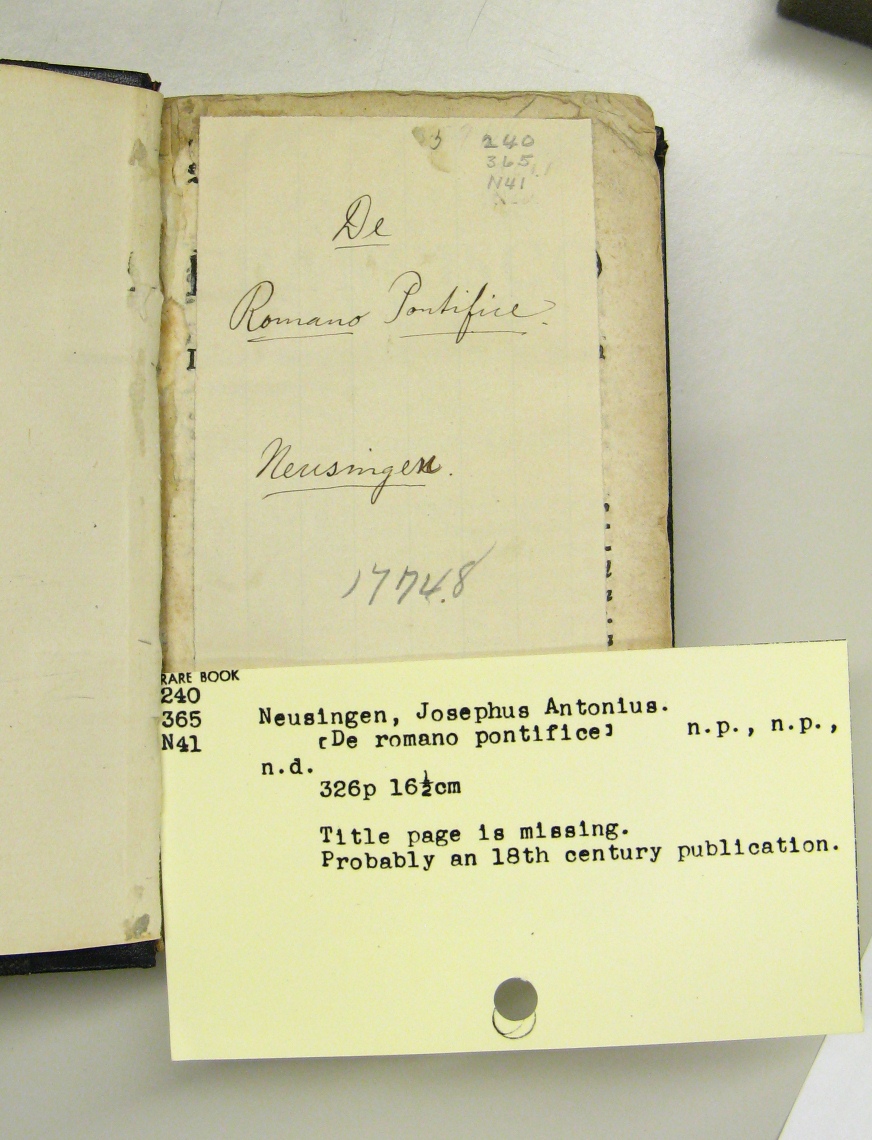
Johann Neusinger. Papatus numquam errans ... (Augsburg, 1709).
Note the confusing title of De Romano Pontifice,
taken from the caption title. The original
cataloger identified the author as Neusingen, not Neusinger.
Many uncataloged items in our arrearages are there because they are incomplete in some way (e.g., perhaps they might be isolated volumes of a large multi-volume set) or because they are combined with other titles in a particularly daunting manner (see my earlier post on "Enough already."  Sometimes, the books merely lack some pages.  Unfortunately, the page that is most often (or most noticeably) wanting is the title page.

Neusinger's title page from the Internet, with earlier cataloging card.
It is amazing how dependent modern readers became upon the title page for information identifying a book.  The earliest printed books did not have title pages--nor colophons, nor pagination, nor lots of other things we take for granted.  For a while in the fifteenth and sixteenth centuries printers and publishers kept much of the most important information about the book in a colophon at the end of the volume.  Here we could find the title of the book, perhaps its author, the publisher's name, the place of publication, the date of publication, and other salient facts that would distinguish one edition of a work from another.

Antonio Pereira de Figueiredo's De non definita in concilio Tridentino (Olisipone, 1766). Note the somewhat unhelpful generic title given by a previous owner ("Dissertatio historico-theologica"), and the partial name of the author.  Fortunately, about 30 pages into the book one can find the actual beginning of the text with a caption title that matches the title page title. No copy of the text was found online, but another institution had already cataloged a copy that appears to match this title (which apparently was only published once).

In the sixteenth century this information moved to the title page for the most part, and now we look there first for a book's identification, and then to the colophon, if there even is one.  But what if the title page is no longer in the book?  There are many reasons a book may lack a title page, which I won't expand upon here, except to say that many of HMML's books are likely remnants of European monastic collections which were "secularized" at some point in the eighteenth or nineteenth century (we know this is true of about 1100 books that came from two Bavarian monasteries). Since title pages often have ownership notes or stamps on them, it is possible that many were removed to obscure the origin of the volumes a long time ago.

Plenarium, dated 1514 (Basel) according to a handwritten note on the book. The volume is lacking its title page and colophon.

One of the wonderful woodcuts in the Plenarium, a collection of Gospel and Epistle readings arranged for the liturgical year.

So close, but no ...  The Bavarian State Library reports two editions of this work published in 1514 in Basel.  They even had pictures of one of these editions available through VD16.  Unfortunately, as we can see, the two pages are dissimilar enough to indicate that this is NOT the item they have photographed. I am still waiting for pictures of the second edition to be put onto the Internet.
HMML has several such works lacking title pages and/or colophons.  Among these are a printed book of hours, a Plenarium (or collection of Gospel and Epistle readings in the vernacular), partial works by Virgil and Pliny the Elder, a commentary on the Song of Songs by Jaime Perez, a collection of inscriptions from the earlier basilica of St. Paul's Outside the Walls in Rome, and several others.

As a cataloger, these books pose special problems, however.  One needs to identify the author and title, and--especially in the case of popular works--the printer, date and place of publication.  Without these, it becomes nearly impossible to identify the work in one's hand.  One movement toward such identification came in the massive 800-volume National Union Catalog of title before 1956.  Today, catalogers and others turn first to WorldCat (OCLC), where nearly all known printed editions are represented.  However, to search a database like WorldCat, one needs certain details--author, title, publication data, etc.

The second volume of Pliny the Elder's Natural History in a 1608 edition from Frankfurt. By searching clues like the commentary by Paolo Cigalino and the printer's device (which also appears at the back of the book as a colophon), I was able to narrow the probably candidates as a matching edition.
I have worked through various sources to identify several of our books in recent months.  With the unprecedented access to catalogs from other countries, I have identified books and editions with the help of WorldCat, VD16 (16th-century books printed in Germany), VD17 (17th-century books printed in Germany), the ESTC (English Short Title Catalogue, the ISTC (Incunabula Short Title Catalogue), as well as services like the Bibliotheque Nationale's Gallica, union catalogs in Italy (SBN), other national library catalogs and union catalog interfaces from across Europe.  And of course, there's always Google, Google-Books, and numerous digitization projects across Europe and North America.

Finally, one example of a search:  HMML has a volume whose handwritten title page identified it only as Canones et decreta omnium Conciliorum usque ad Tridentinum, compiled by Barth. Carranza.  No dates were given, no publisher, etc.  One important clue was the colophon that indicated that the book had been printed at the shop of "Ioan. VVithagij." in Antwerp, Belgium. On the following page was a publisher's device, which I was eventually able to trace to the family of Ioan. Steelsij.  The most commonly reported editions in WorldCat did not match in the number of pages, an important attribute for preliminary comparisons.


Eventually, I was able to establish that most editions I had found were published by the widow of Joannes Steels (as the Library of Congress identifies him in the LCNAF).  This narrowed my focus to 16th-century editions of Carranza's compilation. Since later editions included later Councils, it seemed likely that this edition must have appeared within a couple decades after the end of the Council of Trent, as suggested by the handwritten title. In final desperation, I searched for the name "Carranza" in Google Books, limiting the dates to 1550 to 1560.


Sure enough, Google has a digitized version of the entire book in a copy from the Bavarian State Library. I was able to compare numerous pages and verify that this was the same edition that HMML has.  With that, I was able to print out a surrogate title page to identify our copy (to keep with the book) and to identify a record in WorldCat that matched our copy.

Today, Carranza is on the shelf in the appropriate place!  Now to find some more missing title pages (if I can find any spare time ...).


Sunday, March 18, 2012

Benedictines and Books, part 3

An angel points the way for St. Etheldreda or Audrey (ca. 636-679), queen and virgin.


"Benedictine READ Posters"

As my title indicates, I have already written a couple times on the importance of the relationship between the Benedictines and the history of the book. It is a story that could take many years to describe--more years than I have to be a blog writer. These posters are small, so that they can be easily viewed on a computer. Most of the original pictures in this posting have been adapted from a book in Vivarium, the online image database of the Hill Museum & Manuscript Library: Imagines Sanctorum Ord. S. Benedicti by Karl Stengel (Augsburg, 1625); see: http://cdm.csbsju.edu/u?/SJRareBooks,15000. Only the picture of Saint Benedict (below) comes from a different source.

As always, you can click on any picture to see it enlarged and to see a gallery of images in this blog post.

So, today I would like to offer a little something (something rather "corny" as they say) for the enjoyment of others:  Following the example of celebrities with books instructing us to read, I thought I might offer up a few Benedictine celebrities with their books.  Since I was not authorized to do this on work time, I created these "posters" at home, using pictures from books in the Saint John's Rare Collections. I hope others will enjoy these. Should anyone find fault with my Latin, please direct comments to me, not the public at large!

Blessed Abbot Alcuin of York (ca. 735-804) teaching his community.
Alcuin was a famous educator and author who also helped Emperor Charlemagne establish an important collection of classical literature in his capital in the late 8th century. As the biographer Einhard tells us:

"Another deacon, Albin of Britain, surnamed Alcuin," a man of Saxon extraction, who was the greatest scholar of the day, was his teacher in other branches of learning. The King spent much time and labour with him studying rhetoric, dialectics, and especially astronomy; ..." (Life of Charlemagne, by Eginhard (i.e., Einhard). New York: American Book Co., 1880. Available in Google Books.)


Benedict of Nursia (ca. 480-ca. 547) with his favorite reading, the Bible,
in the Sacro Speco (Holy Cave) at Subiaco, Italy.

In most pictures of Saint Benedict, the founder of Benedictine monasticism, he is depicted holding a book--often a Bible or a copy of his rule for monks. In the poster of Benedict at Subiaco, it is clear that the book is a Bible, since the Rule had not yet been written. The original picture comes from a book on the Sacro Speco in the Saint John's Rare Books Collection. While the Rule of Benedict says relatively little about books per se, it does call upon his followers to read as a regular part of their life as individuals and as community.

Even the Virgin Mary encourages us to read. Rupert von Deutz
receives a book from the Virgin and Christ Child.


Rupert von Deutz (1075-1129) was a famous preacher and theologian in the high Middle Ages. Even though his work was later questioned by Church authorities, he is still studied today.

Saint Walburga with her special "oil" and her book in one hand
and an abbess' staff in the other.


Saint Walburga (ca. 710-777 or 779) also promotes reading in her portrait. Born in England, her remains rest today in Eichstätt, Germany, which is also home to a woman's monastery named in her honor.  The Hill Museum & Manuscript Library has digitally photographed a German-language biography of Walburga which has been added to its image database, Vivarium (http://cdm.csbsju.edu/u?/SJRareBooks,20805).

Finally, to demonstrate the tenacity of the Benedictine readers, I offer this image of Saint Eulogius of Cordoba (martyred in 859):

Saint Eulogius of Cordoba (died 859) who gathered works by Augustine
and ancient Latin authors and brought them to his home in Cordoba.

Happy reading!

Thursday, March 1, 2012

Global Ethiopia and Rare Books


On March 17, 2012, Saint John's University will be the site of the Global Ethiopia Conference, co-sponsored by the Hill Museum & Manuscript Library, the University Library, the English Department and the Center for Global Education.  As part of this one-day conference, HMML will be showing some of the rare books in the Saint John's collections.  Below is a short overview of some of these books. For more on the conference, visit:


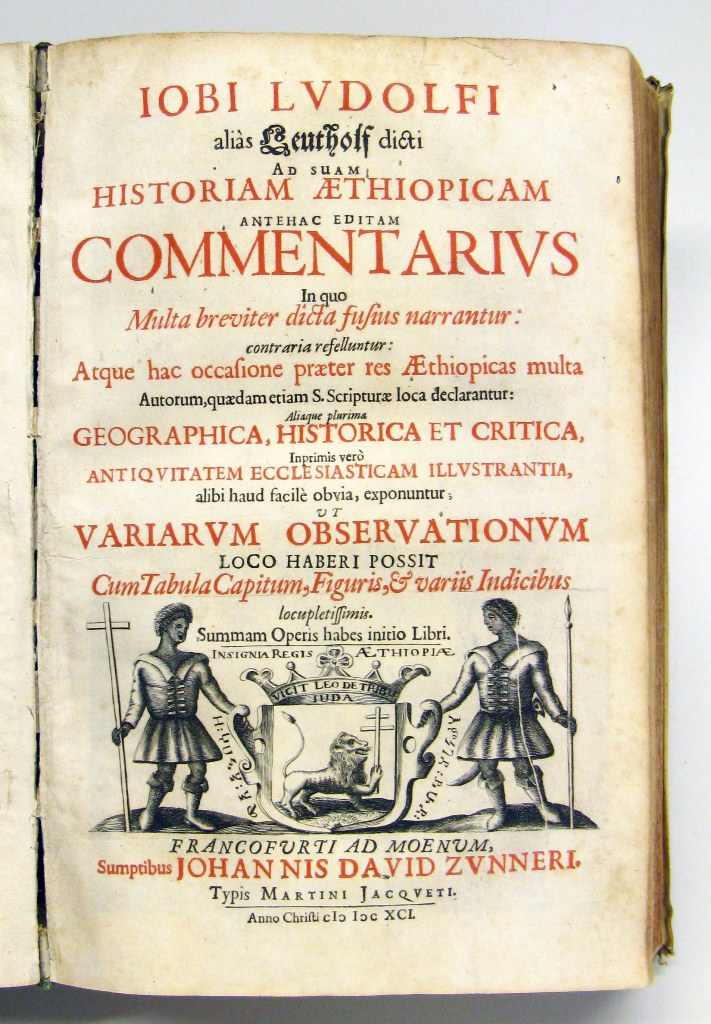
From the Historia Aethiopica by Hiob Ludolf (1681) or its supplement (1691).
Hiob Ludolf (1624-1704) is credited with starting the scholarly research of Ethiopia in Europe.  HMML has his major work, the Historia Aethiopica (Frankfurt, 1681) bound together with its supplement, the Commentarius (Frankfurt, 1691).  His influence can be seen in the rapid dissemination of his works, with English and French editions appearing already in the 1680's.  HMML has a 1684 abridged version in French, as well as a 1701 Psalter in Ethiopic and Latin edited by Ludolf (complete book in Vivarium).

(Click on any image to enlarge it.)


From Ludolf's Commentarius (1691).

Map of Ethiopia from the French abridgement of the Historia Aethiopica (1681).


The rare collections also include French translations of other accounts of Ethiopia, including two from Portuguese and one from English.  There is the Histoire de l'Ethiopie Orientale (or Etiópia oriental), printed in Paris in 1688. This account of life in Eastern Ethiopia includes material on Mozambique, as well) and is based on the Portuguese of the Dominican missionary Joao dos Santos (died in 1622).  Another translation from Portuguese is the Relation historique d'Abissinie  by Jerónimo Lobo (1596?-1678), published in Paris in 1728. This is augmented with numerous essays on Ethiopia by other scholars, including Ludolf.

Another European to wander into Ethiopia was the Scottish explorer James Bruce (1730-1794), who searched for the source of the Nile River.  His account was published in 14 volumes in French as the Voyage aux sources du Nil, en Nubie et en Abyssynie (London, 1790-1792).  The final volume is an atlas of plates, mostly filled with flora and fauna, but also some other scenes from daily life in the Nile River valley.


Joao dos Santos, Histoire de l'Ethiopie Orientale (Paris, 1688).
Jeronimo Lobo, Relation ... (Paris, 1728).
Map from Jeronimy Lobo, Relation ... (Paris, 1728).

From the atlas to James Bruce, Voyage ... (London, 1790ff.)
Finally, we have the renewed interest in Ethiopia among the various works on Africa by British explorers in the 19th century. Richard Burton's First footsteps in East Africa, or, An explanation of Harar (London, 1856) provides a few color plates from that region, while Henry M. Hozier's The British Expedition to Abyssinia (1869) recounts a military invasion by the British to free hostages held by Emperor Tewodros II of Ethiopia.


Richard Burton, First Footsteps in East Africa (1856), title page.


The HMML collections offer other materials on life in Ethiopia, especially religious life and manuscripts (see the earlier post on Ethiopian manuscripts in this blog).  The Global Ethiopia Conference will provide us an opportunity to share these books, manuscripts, and art with a broader audience!

We hope to see you there!

Thursday, February 23, 2012

Enough already!

De sanctissimo divinae trinitatis mysterio, earlier in the library at the Monastery of Ottobeuren,
now in the rare book collection at Saint John's University (Collegeville, MN). More on this title below.


Every cataloger dreads them--multiple titles bound into one item.  And yet, with books (and especially smaller ones) this was a common practice up to the early 19th century, when publishers started issuing books already bound.  Many times these bound-together titles can provide unexpected insights into an earlier time. 

An example of this is a book bound in 1550, according to the date on the binding, but which later came into the monastic library at Ottobeuren (handwritten date of 1598). The first title in the book is a Catholic work called the Loci communes rerum theologicarum by Johann Hoffmeister (Ingolstadt, 1549), and the final title is Encomium aquilae (Tubingae, 1532) written by a Premonstratensian canon who was forced to flee the newly Protestant city of Tuebingen about 1532. 

In between these two "Catholic" works is a title page on which the author's name has been inked out.  Later, someone added the name "Philipp Melanchthon" in ink (his Doctrinae physicae elementa, 1550).  Only then does it become apparent that the outer texts may have been a cover for an author whose close relationship to Martin Luther would not be accepted in a Catholic context.  Now the remaining question concerns the first owner of the book, but unfortunately that information is covered by a later ownership label, which I hope some day to be able to have removed.

And then there are the gatherings of dissertations.  Saint John's has a number of such collections, bound together in one piece, some of them quite early.  One volume bound in pigskin contained 20 different titles, most of which are not widely held in North America.  The ownership note on the first title page indicates that the collection was probably bound in the late 16th century.  The litany of titles required a lengthy note in the catalog record. Here are the contents:

First title: De Sanctissimo Divinae Trinitatis mysterio : disputatio theologica, in celebri et catholica Academia Dilingana, die Ianuarii [sic] publice proposita praeside Georgio Eberhardo ... ; respondente ... Georgio Wölflin (Dillingen, 1588).
This is bound with (see photo gallery below):

-- Mariae Virginis Deique genitricis vita / Joannes Pelecyus. Dilingae : I. Mayer, [1589]
-- De fide virtute theologica disputatio / Joannes Pelecyus. Dilingae : I. Mayer, 1589
-- De spe virtute theologica disputatio / Joannes Pelecyus. Dilingae : I. Mayer, [1590]
-- De charitate virtute theologica disputatio / Joannes Pelecyus. Dilingae : I. Mayer, [1590]
-- De fide, virtute theologica disputatio tripartita / Jakob Mayer. Dilingae : I. Mayer, 1576
-- De ecclesia Christi militante in terris / Joannes Pelecyus. Dilingae : I. Mayer, 1590
-- De originali hominis iustitia et iniustitia / Joannes Pelecyus. Dilingae : I. Mayer, 1586
-- De iustificatione hominis iniusti coram Deo / Joannes Pelecyus. Dilingae : I. Mayer, [1591]
-- De legitimo usu eucharistiae in altera tantum specie / Gregorio de Valencia. Ingolstadii : D. Sartorius, 1587
-- Theologica disputatio, De veritate transsubstantiationis In Sanctissimo Sacramento Eucharistiae / Albert Hunger. Ingolstadii : Weissenhorn, 1577
 -- De augustissimo Eucharistiae sacramento et sacrificio / Joannes Pelecyus. Dilingae : I. Mayer, 1588
-- Disputatio theologica de speciebus Eucharisticis / Jakob Gretser. Ingolstadii : W. Eder, [1594]
-- Disputatio theologica De effectis divinae gratiae / Michael Eiselin. Ingolstadii : D. Sartorius, [1591]
-- De merito proprio hominis apud Deum / Joannes Pelecyus. Dilingae : I. Mayer, [1591]
-- De infidelitate et tribus eius speciebus, ethnicismo, iudaismo et haeresi / Joannes Pelecyus. Dilingae : I. Mayer, [1591]
-- Disputatio theologica de voto et iuramento / Matthias Mayrhofer. Ingolstadii : D. Sartorius, [1589]
-- Theses de descensu Christi ad inferos, et eiusdem ad coelos ascensu / Albert Hunger. Ingolstadii : D. Sartorius, 1587
-- De statu religiosorum / Georg Eberhard. Dilingae : I. Mayer, 1587
-- De tribus peccatorum generibus, mortali, veniali, et originis / Matthias Mayrhofer. Ingolstadii : D. Sartorius, [1587].

Here is a photographic overview of the titles bound into this one volume:

Click on any image to see it enlarged.


And last, and perhaps not least?


Sometimes, the way titles are bound together can give us deeper insight into a time and place distant from our own.  In this case, perhaps, the primary determinant for binding all these titles into one volume was the need to save on binding work in a large library. Either way, these collections pose challenges to the cataloger and his/her stamina!

Now, back to the stacks -- more collections of bound-together titles are waiting!