Search This Blog

Wednesday, July 10, 2013

They Shoot Manuscripts, Don't They?


An Early Account of HMML's Preservation Work (Seitenstetten Abbey, Austria, in 1965)

The Hill Museum & Manuscript Library has pursued the preservation of manuscripts through photographic means for over 48 years now. This has always been the primary focus of our work at the library. Starting in April 1965 at Kremsmünster Abbey (Austria), the project microfilmed over 30,000 medieval manuscripts between 1965 and 1972 in Austria. Documenting our preservation work has become easier technologically in recent years (although the flood of information is a problem in itself), but learning about the early years can still be a challenge.

Already in the summer of 1965, Father Oliver Kapsner, OSB (the first field director for the Monastic Manuscript Microfilm Project--now the Hill Museum & Manuscript Library), recorded the stages of microfilming manuscripts. He even supplied captions to explain these stages (used below). These photos and captions provided a means to bring the work closer to the project's supporters in the United States.  As Father Oliver wrote to Mr. Edward R. Vessel, Jr. on August 2, 1965 from Seitenstetten Abbey (Austria):

"Your letter of July 15 reached me at Lambach as we were closing shop there and getting ready to move to the next Benedictine abbey, Seitenstetten. We are here a week now. As soon as we were set up we had pictures taken of the various steps in our procedure, with the steps numbered, as you can see on the enclosed photos."

Here then, is the sequence (what we might call the "workflow") for microfilming in 1965!

1. Father Oliver Kapsner, OSB, selecting a manuscript from the shelves.


2. Typing up the bibliographical entry. Some of these are very long, several pages, since some bound manuscripts contain as many as forty or more items.


An example from Seitenstetten of the index cards typed up by Father Oliver.

3. Leaving the library (at Seitenstetten, Austria) with an armful of manuscripts.


4. Coming down the long monastic corridor with an armful of manuscripts.
 
5. Entering the camera room or workroom.


6. Inserting the bibliographic sheet into the proper manuscript. This is also photographed, at the head of the manuscript.


7. Camera 1, with the manuscript in place under the glass. The camera operator is P.S. from Vienna.


8. Discussing a problem at Camera 1.


9. Front view of Camera 1.


10. Camera 2, with the manuscript in place. The camera operator is H.R. from London.


11. Camera 2, showing project board, which is photographed on the first frame. The project board reads: Monastic Manuscript Project, Number 838, Filmed by University Microfilms.


12. Packing films to be shipped to Vienna to be developed by Kodak Company.


13. Inspecting the developed film on the Recordak Reader and checking against the original manuscript.


14. Splicing in a retake page.


15. Packing films for shipment to the U.S.


16. The crew with their Volkswagen Minibus, used for transporting the equipment from one monastery to another. (in photo: Father Oliver Kapsner, OSB; and his assistants: H.R. and P.S.)


17. The crew with their Volkswagen Minibus (ready to head off to another library ...).

Friday, May 17, 2013

ExLibris plates from Saint John's


(this never seems to happen to me ...)
I've reported on previous occasions on the "manna experience"--finding something in the rare book room and asking "what is it?"

As always, click on any picture to see it enlarged or to see a gallery of the pictures in this article.
Getting into the spirit of the subject ...

Today's "manna" comes from a single box that was last organized in 1994.  This box contains a collection of book plates or ex libris from the the time of the last turn of the century (i.e., circa 1890-1910).  Twenty years ago the plates were listed and partially identified.  More recently (last year), an intern at HMML expanded the information for many of the plates; however, there remains much to learn about the artists and the owners for whom these plates were created.  Here is a small gallery of images from the more than 1500 bookplates in the Saint John's bookplate collection.

Some of the plates are rather romantically "medieval" in character:

"Buecher-Sammlung Karl Anklam."

"Ex libris Kurt Th. Friedlaender."

Some are humorous:

"Maria Wertheimber."

"Akademischer Gesang-Verein Muenchen."

Some are outright satirical:

Caricature of Beethoven by L. Brunet.


Caricature of Liszt by L. Brunet.

Some are very modern:

"Ex libris Philipp Vock."

Some are playful:

"Ex libris Dr. Iosef Klueber."

Some are even "monastic" (at least in spirit):
"Ex libris Philipp Treier."

The Bookplate Collection is now in the process of moving from the book collections to the art collection under Arca Artium.  There it will fit in well with the broad holdings of printed works from the 15th to 20th centuries, and can provide further evidence of turn-of-the-century taste and art.

The librarian speaks ...


Monday, April 22, 2013

Finding HMML at the International Congress on Medieval Studies (aka "Kalamazoo")


Finding HMML at the International Congress on Medieval Studies at Kalamazoo, Michigan (May 9-12, 2013)

From the Malta Study Center exhibit. Click to enlarge.
As in other years, the Hill Museum & Manuscript Library is participating in several sessions and activities at the International Congress on Medieval Studies next month.  I've listed sessions below where HMML staff will be involved.  In addition to sessions with papers, HMML will again hold its own reception on Friday night, but this time in the Fetzer Center (room 2020).  We hope you can join us!


The Malta Study Center has arranged for a display of panels commemorating the 900-year anniversary of the papal bull of Pascal II and the establishment of the Knights of Malta. The display will be at the Department of Special Collections in the Waldo Library. For a preview of these panels, go to Theresa Vann's Melitensia Blog:

http://melitensia.blogspot.com/2013/03/900-years-of-faith-in-action-1113-2013.html


Here is a listing of HMML staff activities at Kalamazoo:

Thursday 10:00 am
Session 4
Valley II 202

War and Schism in Iberia of the “Calamitous Fourteenth Century”
Sponsor: De Re Militari: The Society for Medieval Military History
Organizer: Donald J. Kagay, Albany State Univ.
Presider: Theresa M. Vann, Hill Museum & Manuscript Library
  • Pere III of Aragon and His Sons in War and Schism: Warfare and Religion in Fourteenth-Century Iberia
    Donald J. Kagay
  • Castile’s Fourteenth-Century Peninsular Wars within the Framework of the Great Western Schism
    L. J. Andrew Villalon, Univ. of Texas–Austin

Friday 8:30 pm
Fetzer 2020

Hill Museum & Manuscript Library (HMML)
Reception with open bar

Saturday 3:30 pm
Session 500
Schneider 1275

New Developments in Digital Resources on Medieval Austria, Germany, and Switzerland
Sponsor: Hill Museum & Manuscript Library (HMML); Society for Medieval Germanic Studies (SMGS)
Organizer: Matthew Z. Heintzelman, Hill Museum & Manuscript Library
Presider: Theresa M. Vann, Hill Museum & Manuscript Library
  • Digital Resources on Things in a Domesticated Space
    Ingrid Matschinegg, Institut für Realienkunde des Mittelalters und der frühen Neuzeit, Österreichische Akademie der Wissenschaften
  • Finding What You’re Looking For: Hill Museum & Manuscript Library’s Online Search Systems and Finding Aids
    Wayne Torborg, Hill Museum & Manuscript Library
  • The vHMML Project: At the Crossroads of Digital Humanities and Manuscript Studies
    Matthew Z. Heintzelman

Sunday 8:30 am
Session 524
Valley II 202

The Nine-Hundredth Anniversary of the Order of the Hospital: Hospitaller Rules and Statutes I
Sponsor: Hill Museum & Manuscript Library (HMML)
Organizer: Theresa M. Vann, Hill Museum & Manuscript Library; Helen J. Nicholson, Cardiff Univ.; and Jochen Burgtorf, California State Univ.–Fullerton
Presider: Jochen Burgtorf
  • Living Up to an Ideal: The Hospitallers in L’Estoire de Eracles
    Philip Handyside, Cardiff Univ.
  • The Function of Hospitaller Houses in England, Ireland, Scotland, and Wales
    Christie A. Majoros, Cardiff Univ.
  • Interpreting the Regulations: The Hospitallers’ Interpretations of the Rule and Statutes in England and Wales
    Helen J. Nicholson

Sunday 10:30
Session 576
Valley II 201

The Nine-Hundredth Anniversary of the Order of the Hospital: Hospitaller Rules and Statutes II
Sponsor: Texas Medieval Association (TEMA)
Organizer: Theresa M. Vann, Hill Museum & Manuscript Library; Helen J. Nicholson, Cardiff Univ.; and Jochen Burgtorf, California State Univ.–Fullerton
Presider: Helen J. Nicholson
  • William of Saint-Stephen’s Saterian (1296): Reflections on a Hospitaller Legal Treatise
    Jochen Burgtorf
  • Who were the Hospitallers' 'Poor?'
    Jyri Hasecker, Westfälische Wilhelms-Univ. Münster
  • Issues of Textual Authority: Additions, Emendations, and Glosses on the Statutes of the Order of the Hospital
    Theresa M. Vann

We hope to see you in Kalamazoo!!!!

Peace

Thursday, April 11, 2013

Look inside the book. Remember, always look inside the book ...

Oscar Wilde autograph, dated March 22 (1898?).

[Please note that digital images in this posting are mostly smaller than usual.]

A few weeks ago I struggled with an anomalous copy of Oscar Wilde's Ballad of Reading Gaol.  The problem was that our copy did not match any described copies that I could find in online or printed bibliographic resources. I did finally decide to catalog the item as possibly a "second edition" copy with a first edition title page.

One trait of that copy stood out, however: there was what appears to be an authentic signature of Oscar Wilde pasted onto the verso of the title page. Pretty cool to find an autograph of a famous person in an unexpected spot. In fact, recently I have come across several such surprises. 

HMML does have collections of signatures that were intentionally gathered--the best-known example is the Kritzeck Collection, which contains dozens of signed documents from popes, saints, kings, emperors, tsars, and presidents.  Visitors are always impressed when we can pull out letters signed by Henry VIII or Elizabeth I of England. This collection came to Saint John's University in the 1960's.

More recently we have been inventorying a very large collection of handwritten documents from Italy, divided into sub-collections of popes, nobility, cardinals, artists, and other noteworthy (chiefly Italian) personalities. Unfortunately, most of the persons represented in the Jude Koll, OSB, Collection are hardly household names today, although among the nobility is at least one letter signed by Louis XIV of France.  But we continue to work on making these materials available to the outside world.
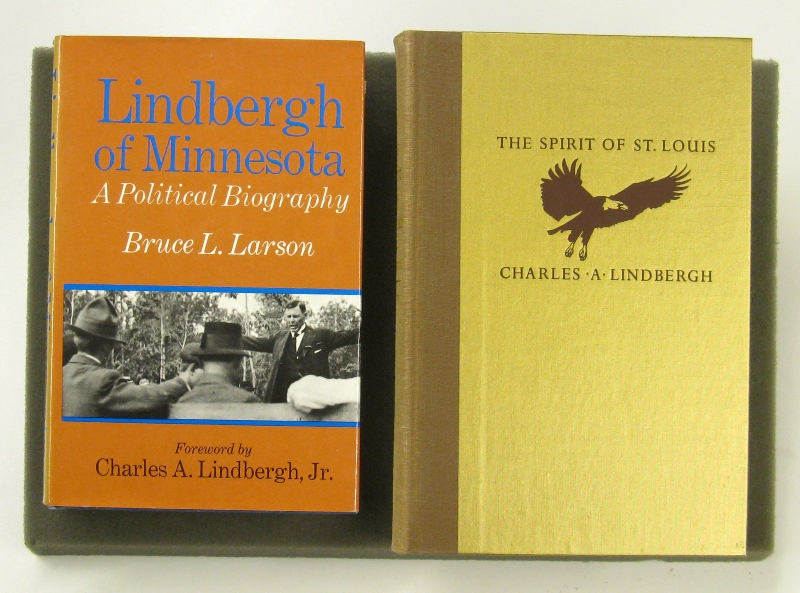
Biography of Charles A. Lindbergh, Sr., and the
younger Lindbergh's story of his historic flight in 1927.
 Just this past week, however, I was reminded of the immediacy of so much of our history.  In the course of processing books from a large donation of materials on Minnesota history and culture (the Anderson Collection), I found a biography of the first Charles A. Lindbergh (1859-1924), a prominent lawyer and politician, as well as the father of the famous aviator. Earlier in the week I had cataloged a later edition of the younger Lindbergh's The Spirit of Saint Louis (1975), which I discovered contained an autograph of Anne Morrow Lindbergh (1906-2001)!

My initial instinct was to send Lindbergh of Minnesota (1973) to our general university library for the circulating collection, only to find that it had been autographed on the title page by both the author (Bruce L. Larson) and by Charles A. Lindbergh, Jr.!

Autographed title page.
Considering the fact that Lindbergh grew up on the Mississippi River, only about 25 miles north of where I now live, I was struck by how close this signature made me feel to an historical figure from a very different time. For a collection dedicated to Minnesota history and culture, this autograph from a "famous son of the state" makes this copy much more special.

This copy of the Spirit of St. Louis is signed on the half-title page by Anne Morrow Lindbergh.
Since this discovery--which I shared with my colleagues at HMML--I have found three additional titles by Anne Morrow Lindbergh in which she signed her name or inscribed the volumes.

It is not entirely unusual for me to find signatures in our books, although most often they are signature of the author or are there to verify the authenticity of the book.  Many of these appear in colophons and include prominent book artists like Eric Gill or Rockwell Kent.  Among the author's signatures we have Tennessee Williams, Kurt Vonnegut, Maud Hart Lovelace, Sinclair Lewis, and several others.

Another name that appears in our books is Harry Reasoner (1923-1991), the famous television journalist, who studied for a while in Minnesota, and who wrote a novel that takes place in the Twin Cities--Tell Me About Women (1946). Younger readers may not remember this name, but for many baby boomers, Reasoner was regular presence in national television news for decades.

Cover of Harry Reasoner's Tell Me About Women (1946) and Harold Stassen's Where I Stand (1947).


Inscription by Harry Reasoner.
A very young (23-years old) Reasoner inscribed this copy of his novel to "Bob + Mary Adams - with pleasant memories of military life + all the best always" and dated it April 16, 1946.


Former Minnesota governor, Harold Stassen (1907-2001).
Harold Stassen (1907-2001) served as Minnesota governor from 1939 to 1943, and later ran several times for the Republican nomination for U.S. president, as well as for other offices.  Here he has signed a copy of his manifesto, Here I Stand! which came out shortly before the 1948 presidential election cycle in which he was very active and influential.

This leaves us with two final examples today:  James J. Hill and Henry H. Sibley.

Like Stassen, Henry Hastings Sibley (1811-1891) served as governor of Minnesota, being the first in that capacity (1858-1860). He also led troops during the 1862 Dakota War, and his stone house still stands in Mendota, Minnesota.

"with best wishes of his old friend"

In a copy of the second edition of Edward Neill's The History of Minnesota from the Earliest French Explorations (1873), we find an inscription from H.H. Sibley to "N.W. Kittson with best wishes of his old friend." Suddenly, this volume, which was merely a duplicate copy (and not the one in better condition) previously, had become a link back to the earliest days of statehood in Minnesota!  Not only that, the inscribee (so to speak), is none other than Norman Wolfred Kittson (1814-1888), a prominent fur trader and entrepreneur in early Minnesota, and for whom Kittson County (in the uppermost northwest corner of Minnesota) is named.

Edward Neill's History of Minnesota came out in at least five editions between 1858 and 1883.


Finally, one of my favorites, because it is linked directly to the name of our library:  HMML has also received two copies of James Jerome Hill's Highways of Progress (1910) as part of the Anderson Collection that came in 2012.  I was somewhat disappointed to find that the Saint John's University library already reported having a copy of this title, only to find upon further investigation that their copy was a 1960 reprint, while our two copies (both signed by James J. Hill) were from the original 1910 edition.

Title page of Highways of Progress (1910).

One of the two copies is inscribed to Walter Henry Sanborn (1845-1928), who came to Minnesota from New Hampshire in the 1870's and practiced law for several years, before being named to a federal judgeship in Minnesota in 1892, where he served until his death.

Inscription to the "Hon. Walter H. Sanborn," dated Oct. 12th, 1910.


As with so many items in our special collections, these books bear witness to friendships, collaborations, contacts, and other kinds of special relationships of the past.  These names bring back to life a time that would be harder to imagine without these very human indications that the book actually passed through the hands of the author and/or belonged to someone significant in Minnesota history.

Perhaps on another occasion I can write about some of our other "autographs!"

Peace.

Monday, March 25, 2013

Never before seen ... on the HMML blog!

Three new books for the Saint John's Collections, with brown tape for binding.
So my boss comes to me last week and says something to the effect of "oh, by the way, there are about three boxes of books in my office that are to be reviewed for addition to the rare books collections."  Oh, OK.

This happens every so often: a box arrives, or the phone rings, or an e-mail pops up with news of a gift (or intended gift) to the Hill Museum & Manuscript Library and/or Saint John's University Rare Books.  In recent weeks I have written about the largest gift from the past few years--the Anderson Collection of Minnesota history and culture.  I am excited to say that examples from this gift are on display at the library until the summer of 2013.

This week, however, I would like to look a couple books from the latest gift to the library (with apologies for any fuzzy photos from my "point-and-shoot").

Ostrich racing?
For many years the Benedictine community at Holy Cross Abbey served the area round Canon City, Colorado.  Like Saint John's Abbey, Holy Cross was an offshoot from Saint Vincent's Archabbey in Pennsylvania.  The community started with just two monks in 1886, although it grew over time.  For many years they operated a school, just like Saint John's, but the school closed in 1985.  The abbey itself closed in 2006.

During their time at Holy Cross, the monks gathered a small collection of rare books, some of which have been donated to Saint John's.  I will share three of the more interesting items with you today.  The first is volume 2 (only) of Hinrich Lichtenstein's travels to southern Africa in 1803-1806.  HMML has a small collection of materials related to eastern Africa (in particular, Ethiopia), but (I believe) this is the first in our holdings to offer material on the southern tip of that continent.

Title page of Lichtenstein's Travels.

Map of Southern Africa.

Images from Southern Africa.


Another title adds to our small holdings in the natural sciences.  Pietro Andrea Mattioli (1501-1577) was born in Siena, Italy. He practiced medicine at the Hapsburg courts and made major contributions in the area of botany.  This gift included a 1573 edition of Mattioli's Discorsi, which provides an encyclopedic overview of plants--based on the Dioscurides of medieval traditions--along with some explanations of animal life, as well as agricultural scenes (dairy farming, bee-keeping).

Title page of Matthioli's Discorsi.
Click on any image below to see it enlarged.


I'm not sure this should be "mele" or "melee"!
Also in Matteoli's volume is a brief discourse on distilling, which includes pictures of a few distillation furnaces:


Since Saint John's already has a substantial collection of Bibles, it is great that we can point to an addition to our holdings here as well.  In 1657 the German publisher Christian Kirchner (with the help of printer Johann Wittigau) produced a very large "polyglot" Bible, although substantially smaller than the polyglots from Spain, Antwerp, or London.  In this case, the languages include Greek, Hebrew and Latin (not the many other languages that often appear in polyglot Bibles). This Bible comes in one volume, with the pages starting at both the front and the back.  In the front appears the Greek New Testament, along with the Old Testament books that do not appear in the Jewish Bible.


In the back of the same volume appears the title page for the Old Testament in Hebrew (with interlinear Latin translation):


This edition is linked back to the Antwerp Polyglot of Christopher Plantin (also called the Biblia Regia, published about 1570) and the Complutensian Polyglot from 1514-1517, thus showing the continuing influence of sixteenth-century scholarship.  The Arca Artium Collection at Saint John's includes a copy of the the Plantin Polyglot, in eight volumes; meanwhile, our neighbor, Alcuin Library, has a facsimile of the Complutensian Bible, as well.  Combine this with the London Polyglot (in the Saint John's Rare Books Collection), and we have a very good offering for those studying the Bible, the transmission of the Bible, as well as Early Modern and/or Reformation history.

There are other books in the gift from Holy Cross Abbey, to be sure.  Perhaps I will discuss some of those on another occasion. For now, these three volumes have made the pilgrimage to Brother Andrew, the "book doctor" at Saint John's.  All three volumes had been repaired at some point with heavy brown tape, which has dried and is falling off (leaving a residue).  In addition, a couple have yellow tape holding in some of the pages.  Brother Andrew will remove the tape and do what he can to repair the bindings responsibly, without major loss of binding information!

Until next time, happy reading!

Peace.